Joy in the Face of Grief

Our pastor has been preaching about grief for the last few weeks.  I still need to watch the first sermon, “Hope in the Face of Grief,” but after hearing last week (my title – “Joy in the Face of Grief”), I know I need to do that very soon.  If you’re interested in the sermons, you can find them on the Media page at www.gvbc.org.  For a bit of background and a base to jump from, the text for last week’s sermon is John 16:17-24 where Jesus is preparing the disciples for his imminent death, and the definition of grief Bobby uses is “a God-given emotional response to a significant loss in your life”.  You know what my significant loss is, but that loss could be anything: a job, the death of a loved one, a change in health – anything that significantly impacts and changes your life.

I won’t repeat the sermon (go watch it for yourself), but I will share a few things I gleaned from it.  My grief is a gift from God, and my joy is not earthly, fleeting happiness; it is the enduring joy of the presence of Christ in my life.  My grief is not abnormal or sinful; it is the normal and healthy expression of the pain of loss.  My questions and doubt are a natural byproduct of sorrow, and they have strengthened my faith insofar as I have made God the foundation on which I build.  No matter what, God has my best interests at heart, and he has planned good things for me, even when they aren’t the things I would have chosen for myself.

The last three years have been a loooooong journey through grief.  And doubt.  And fear.  And love.  And hope.  But no matter how much I have questioned, the base I jump from is always God.  I could share many Bible verses that have caused me no end of frustration and doubt; I have shared with you much of the experience that has caused great doubt and pain.  I hope I have done a good job of sharing why I haven’t jumped off a cliff yet.  Whenever I feel completely lost and sinking, I go back to basics.  What exactly do I believe and why?

Step one: do I believe there is a god?  I know there are dozens of scientific theories on creation, but I cannot look at the earth – the creek in my back yard, our bodies, the “natural law” we humans spend so much time trying to define with equations and numbers – and think this was a random cosmic hiccup.  I believe that there is a Creator God.  Step two: how do I know that I believe in the right god?  Rationally speaking I don’t.  By faith I believe that God sent his only son, Jesus, to die and live again to allow me and you to have a relationship with him.  I can’t scientifically prove to you that there is a god or that my God is the one true God.  I know in my heart that it’s true, and my life and my words should bear that out.  Step three: how could a god who loves me allow this to happen?  I still can’t really answer that except to say that God is always doing bigger things than we can see.  One example is this blog.  Mabbat wouldn’t exist if I hadn’t felt the need to share my losses and my experiences.  If a single person has been helped or comforted by something I’ve shared, then God has used my grief to do something good.  I can live with that.  It still sucks, but I can live with it.

I don’t know that I learned any new material last Sunday, but God used Bobby’s words to speak to my heart and tell me that I am on solid ground.  I have found joy in the face of my grief.  My sorrow will someday soon be turned into joy.  I am moving in the right direction.  There are times when I have been crippled by grief; there are still days when I have to stop and cry for no apparent reason; but I am able to see the good things in my life.  I have a deeper faith than I ever knew, I have a wonderful husband who has managed to stand by me even when I push him away, I have great and supportive people in my life, and I am learning to see how strong and beautiful I am as a child of God.  That is my joy.

To Have Faith and Never Doubt?

That title is a phrase I heard on the radio this weekend as joyously and peppily proclaimed by a Dixie gospel group.  The song lyrics posited that to have faith and never doubt are essential to walk with Christ (and just for good measure, they sampled “Victory in Jesus” as a bridge between the second and third verses).  The message was somewhat oversimplified, but I would venture to say that this thought is widely accepted as doctrine: doubt is not only counter to faith, but also sinful in nature and naturally excluded by the presence of faith.  I beg to differ.  Faith that has never been questioned or doubted is not a very strong or deep faith.  It is faith that has never walked.

Before semantics become an issue, I am using the words “doubt” and “question” as essentially the same.  According to www.dictionary.com, doubt is “to be uncertain about; consider questionable or unlikely; hesitate to believe” or “to be uncertain about something; be undecided in opinion or belief.”  Question is not only a sentence in interrogative form, but also “a matter of some uncertainty or difficulty” or “to make a question of; doubt.”  Doubt and question are synonyms with some obvious shades in meaning, but synonyms all the same.  I have heard people say that it’s okay to question your faith but not to doubt it.  I think that’s asking a bit much of syntax.

Where does questioning become doubt, and why are we so afraid of doubt?  The bottom line seems to be that we are afraid to find out we might be wrong and that our faith has been for naught.  We hope for irrevocable proof that our God is both real and right, and we are right to follow him.  Guess what, Thomas?  We won’t get that kind of tangible evidence this side of heaven.  We can hear echoes and glimpse flashes of Truth, but we will not know God the way that he knows us until we are standing in his presence.  Until that time, we are left here on earth to wrestle with faith and doubt.

The church tends to condition us not to express doubt.  When was the last time you heard anyone in a Sunday School class say there were days when they questioned the existence of God or the resurrection of Jesus?  Can you hear the collective gasp and cry of blasphemy?  But, if you are a Christian, haven’t you had moments where you wondered if you’d missed the boat?  What is gained by hiding those moments from each other?  After two years of constant doubt, I felt embarrassed to go to church.  It was pretty easy to slip in late for the morning service or only show up at night with the smaller crowd, but I dreaded being in a small group like Sunday School because I didn’t want to answer any direct questions about my faith.  For two years, I defaulted to answering questions with some variation of, “Well, Paul says fill in the blank in Romans.”  I didn’t speak of my own thoughts or beliefs to anyone but my very, very best friends (maybe only two of them, actually) for almost two years.

I was in fact terrified to talk to anyone except my best friend about matters of faith.  What if they discovered that I had no idea what I believed anymore?  What if I couldn’t figure out what I believed at all?  At that point in my life, I had been a Christian for twenty years.  It shattered my world to have no idea which end was up.  If you are an ocean swimmer, imagine the worst rip tide you have ever experienced; you are caught underwater, being swirled and pummeled and forcibly moved by water that you can’t see through or control, and you have no idea which way the surface is or when you will next breathe.  At some point, you will either drown in the current or you will find your way back to the top and open air.

My foundations were solid, and I knew I wouldn’t drown, but it made for a terrifying few years.  Every time I attended church or read the Bible, I was confronted with some doubt that had to be wrestled into submission.  It was exhausting to think of doing all of that work by myself.  I have no doubt that it was unnecessary for me to be or feel alone – now.  I have no doubt that there are saints capable of never doubting, but I doubt that I have ever met one.  I do feel comforted to find myself in good company as an occasional doubter: the disciple Thomas, John the Baptist, and Mother Theresa all doubted.  I still wonder, if we don’t see those examples as sinful, why do we condemn ourselves as such for expressing a question?

Sometimes setting may be the issue.  It isn’t always appropriate to express every doubt to everyone.  For instance, if my questions are more in line with a specific doctrine about women’s roles in the church, I really shouldn’t espouse those questions to someone who struggling with the very idea of God’s existence or his goodness.  But I shouldn’t dismiss the doubts of someone who is struggling with something I may already have come to grips with.  I guess I’m going back to the shoeless man example, but we’ve got to help each other with what really matters without condemning the doubter as a heretic.  If our faith is never questioned, it is never tested or proven.  Would you rather go diving into the ocean with scuba gear that has been quality tested, or would you rather try your luck with second-hand gear that hasn’t seen light or water in decades?  I think of doubt as the quality test or the annual inspection my air tanks have to pass.  Questions allow us to test for weak spots and fix them before they become life-threatening issues.  That singing group can proudly claim to never doubt, but I have faith, and sometimes I doubt.

Feeble Hearted

Without adding any details, there is a situation I have to deal with fairly constantly.  We will call it “the Zebra” for the rest of this post so that I don’t have to find creative synonyms for “situation” or try to vaguely describe an interpersonal conflict.  The Zebra is inescapable and largely unconfrontable.  Most of the zebras in my life are workable for the most part, and they don’t seem to present the same level of angst this Zebra causes me in under a minute.  I am at a complete loss for actionable direction, and I am struggling to find both a Christlike response and a confirmation that Christ even exists in this situation.  (Please hold all the rotten tomatoes until you finish reading – I am not saying that Christ does not exist.)

The root of the problem with the Zebra is actually a problem with myself, although there is much that ideally should change with the Zebra.  The root problem is that I am feeble-hearted: I cannot always outrun the feeling that I am a failure because I have miscarried six times; I can run hard and fast, but the inadequacy will catch me when I least expect it.  Unfortunately, I thought I had enough breathing room to stop running for a while, and now I am fighting for air again.  I also feel like I have failed when I can’t accomplish all of the things that I need to do, not to mention the things that I would like to do, which happens just about every day.  Even though I know that what I do does not make up all of who I am, I find myself lost in the to-do list and wondering if I will ever get anything right.  The Zebra only magnifies my feelings of failure.  I would venture to guess that none of the parties involved in the Zebra even know how I feel, partly because I don’t know how to tell them, and partly because they won’t ask.

It seems that the more I ponder the situation, the deeper root of my frustration is that I rarely feel adequate, which is ridiculous because I know that I am a very capable person.  My entire life is built on the foundation that I am a creation of God, who loved me enough to die for me so that I can know him and worship him forever.  That should be enough.  That should render the Zebra miniscule and incapable of causing me frustration and pain.  So, why does the Zebra hold such power over me?  The first thing that pops into my head is that my faith is inadequate.  I allow the Zebra to invade more ground than it should hold in my heart and my mind, and certainly I could work harder to devote my entire thought life to Christ.  But the Zebra has proven that no matter how hard I try to accept its inane presence in my life and chalk up the injuries it causes to the Zebra’s untrained nature, the Zebra manages to do something so outrageous that I can’t pretend it is an acceptable situation at all.

Here is the difficulty in finding Christ in this situation: it feels like I am being pushed past what I can handle, and there appear to be no viable coping strategies.  It would be a simple thing to handle if Christ were more tangible in this situation, but I can’t see or hear or feel the directions for taming the Zebra that he must be providing.  And I can’t decide what action Jesus would take here: continue to turn the other cheek or turn over tables in the temple.  The other cheek option is causing no end of stress and dysfunction in my life.  Turning over tables would likely permanently damage some relationships that would then cause no end of stress and dysfunction in my life.  I am terribly afraid of the fallout from any real confrontation with the Zebra, but I don’t know that I can continue to pretend everything is fine with a Zebra running amuck.

I can completely see that I am following in Job’s mistaken footsteps: by questioning God’s motives and his control over the Zebra, I am really deflecting any serious introspection and weakening my focus on God’s character.  I do have the advantage of supportive friends, and I know that God uses them to encourage me in a very tangible way.  But like Job, my fatal flaw is wanting the Zebra to just go away so that God will prove that I am righteous in my pain and indignation.  Alas, there are no such magic bullets, and if I have learned nothing else in the last few years, I have learned that God doesn’t work that way most of the time, and I probably couldn’t love him if he did.  I just want to hear, “Well done, good and faithful servant,” and I wish I could hear it right now; it would make it a lot easier to tell my feeble heart to buck up and keep going.

Notes on Choir

I know, but I couldn’t help myself with the title.  For most of my life, I have sung in choir.  In fact, I earned a perfect attendance award one year in the church children’s choir; I mention that award because it was one of my proudest achievements until a freakish P.E. award in middle school – but that’s another post.  I learned from the band director within the first week of middle school that I had no rhythm (and he was right – I can’t clap and sing at the same time), and if I couldn’t play drums or a trumpet, I wasn’t interested in the band, thus sealing my fate as a choir member.

In high school, I continued to sing in the concert choir and the show choir (think Glee without all the angst and obvious sex).  I still reference most of my time in high school by the pieces we were singing in choir: “Odysseus and the Sirens,” Hilaritas, “Johnny Be Good,” Cole Porter, and Bach chorales.  I sang in assorted choirs all through college, but after getting married and moving to a new church, I never joined the choir.  I sang with the ensemble in Christmas productions, but I hadn’t been in choir in almost ten years until I started going to practice in the fall.  I am officially a second soprano now, which has been an adjustment from a lifetime of alto and occasional tenor singing, but I can hit most of the notes, and my eyes have almost gotten used to watching the director from the other side of the loft.  Adjustments aside, I feel like I’m home in the choir for a lot of reasons.

A good piece of music is a microcosm of the body of Christ: it is a collective effort that cannot be accomplished by one person alone, and everyone involved has a different job to do.  There must be a composer, a director, people to play the instruments, people to sing the parts, and people to hear the song.  Every Sunday morning in the choir loft, I am reminded at some point that I am one voice among many, and I can identify the individual voices in my section along with the harmonies of the other sections.  It is extraordinary to hear the individuals become one collective voice, and it must be a little bit like what heaven will be.  One of my favorite exercises in high school choir was standing in a big circle around the room to sing whatever piece we were working on; wherever you stood in the circle, you heard every part as if it were a single voice.  The piece I most remember from that exercise is “The Last Words of David;” our director told the accompanist to play, and then she turned all of the lights off.  The first phrase was like a wall of sound with all these crazy chords that gave us all chill bumps.  I think that’s still my favorite choral piece, even after everything I have heard or sung since then, and I will never forget how it sounded that day in the dark.

As amazing as it was to sing with such an incredible group of voices in high school, it is even better to be singing with our church choir.  They, too, are an amazingly talented bunch, but the focus is not on winning competitions or competing for solos: we are there to tell about God’s love through music.  And I feel like the choir members demonstrate that love by the way they care for each other.  Of course there are all of the foibles and follies that humans are prone to – you can’t put people in a room together and never have disagreements or personality conflicts – but this is a group that prays for each other and expresses genuine concern for each other in spite of all the different personalities and ages and professions present in such a large group.  It doesn’t hurt that our director leads by example, either.

My work day was insane yesterday.  I had (make that still have) an enormous pile of paperwork on my desk and several fires to put out through the day, so by the time I left for choir practice, I was frazzled to say the least.  Once we started singing, though, the mess of the day was gone, and I was home.

Shorthand

Court reporting has always been the most mysterious part of a courtroom to me.  I am a hunt-and-peck typist, and all of my efforts to learn correct typing skills have resulted in frustration and laughter from Mavis Beacon.  She’s a really mean computer program, I tell you… okay, mostly because I enabled sound effects that apparently mock you when you hit a wrong key or type too slowly.  I never took typing or keyboarding in school, either.  It may shock you to learn that my elective schedule was too full with art class, math team, choir, and Spanish.  I have honed my hunt-and-peck skills, so that you probably wouldn’t notice that I can’t type without looking at the keyboard, but my speed severely limits my ability to take dictation of any kind.  Understandably, court reporting is out of the realm of possibilities for me: you not only have to type at the speed of conversation, but you also have to know and understand a special shorthand.  Maybe it is the magic of motion pictures, but I am always astounded when the court reporter on a television show reads back several minutes of dialogue from what appears to be three inches of adding machine tape.

But we all have forms of shorthand that we use every day.  For instance, if you have a profession, there are terms that you use that apply strictly to your trade.  Every hobby you have requires a working knowledge of the craft or activity you are attempting to complete.  I recall looking at the information for the triathlon I conned my best friend into entering with me, and wondering, “What in the world does T1 and T2 mean?”  All I knew up to that point was swim, bike, run (What do you mean I have to transition?!).

Sometimes, shorthand can be a barrier to real communication.  Many regular church attendees, especially in the Bible Belt, have a hard time avoiding “religious” or “church” words when they are talking to someone who isn’t familiar with the lingo.  “I was backsliding until I repented of my sins and rededicated my life.”  Chances are, if you’re not Southern Baptist, you don’t really understand what that meant.  I would guess that even if you did understand it, you fall into one of two camps: Camp A which sees no issue with defaulting to the lingo, or Camp B which is frustrated by the lingo because it so often falls short of truly expressing the heart and soul of your faith.  I suppose it’s evident that my tent is pitched in Camp B.  The problem with exclusionary shorthand is that you prevent an outsider from coming into your campground and staying long enough to roast marshmallows around the fire.  I can think of nothing that should be more clearly communicated than the truth of who God is and how he loves us, yet we often entangle ourselves in the semantics or catch phrases.

But shorthand can be useful, too.  In the church example, there is an amazing shorthand among followers of Christ: there is (or should be) an immediate family connection, and they already know the most important things about you without asking a single question.  If you tell me you follow Christ, then I already know you are my brother or sister in faith, and the rest is just details as the saying goes.  I have some beautiful friendships that have developed on that foundation alone.  This blog has also provided a shorthand among my friends.  It allows me to share more than I would either be willing or able to do in a quick conversation, which means that most of my quick conversations have immediately started on a deeper level.  It has allowed others to share things they probably wouldn’t have otherwise, which offers me a shorthand to their struggles, too.  It has turned us into court reporters of the heart, if you will, and that quick and deep plunge into friendship is priceless.

We’re All Just a Bunch of Crock(ery)

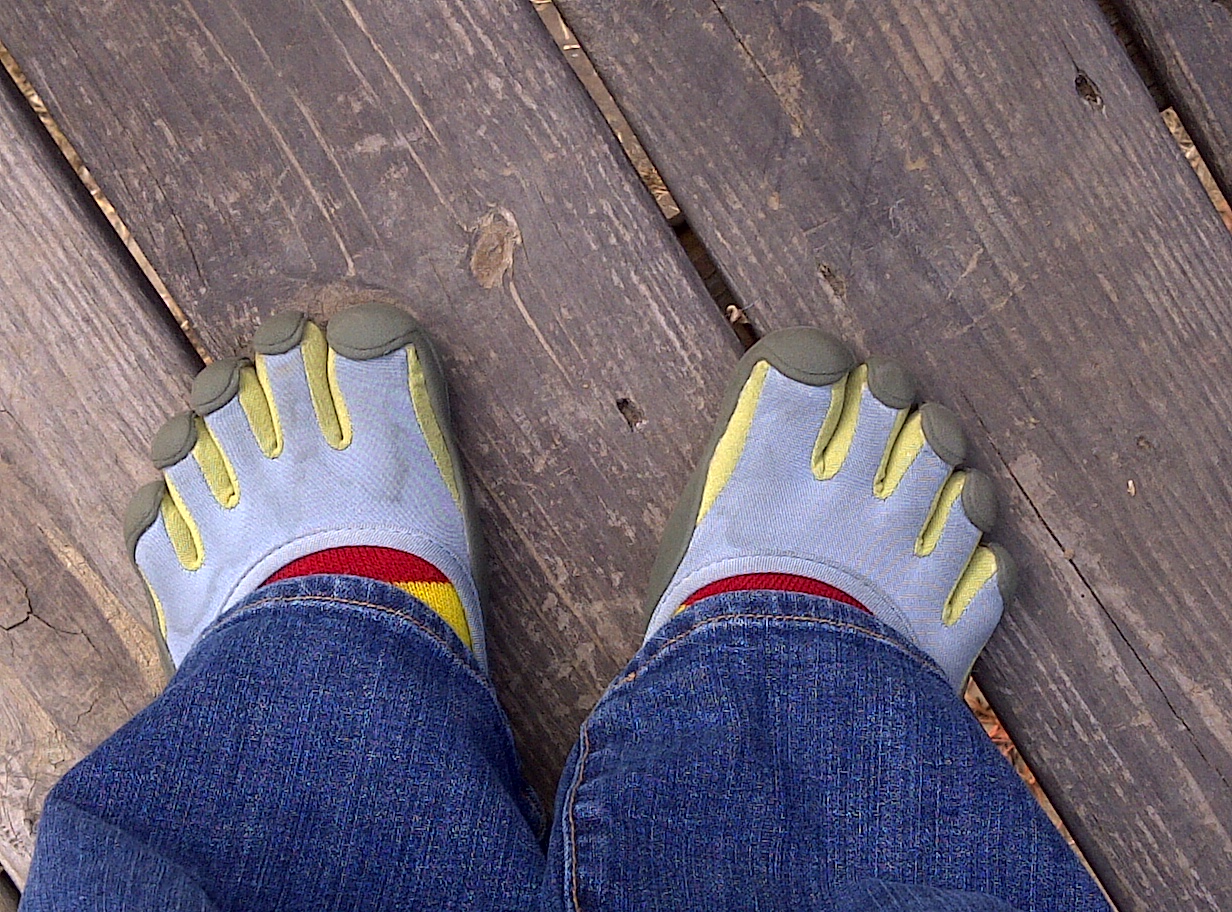
Several months ago, I purchased a pair of Vibram Five Fingers shoes.  In case you haven’t seen them, they are pictured here (made even more obnoxious by the addition of striped socks – I am on a mission to find more toed socks today as all the toed socks I own are some variation of stripes or hearts).  I personally find these shoes to be the most comfortable pair I own; it feels like walking around in your socks all day.  I’ve had a really bad case of plantar fasciitis among all of the other issues my feet have had from birth, and, rather counterintuitively, walking and running in these shoes or barefoot is helping tremendously.  However, I do not recommend these shoes to anyone without a healthy sense of humor and at least a small dose of confidence, for you will be mocked.

My Five Fingers have been conversation starters as well as the butt of many jokes around the office (I now wave goodbye to my office roommate with my toes whenever I’m wearing them) and various checkout lines.  I have adopted a new motto regarding my footwear, though: Blessed are you who are mocked for your choice in shoes, for your feet shall not ache nor blister.  Perhaps slightly sacrilegious, but true in my case.  I tend to forget what they look like, so I forget that other people might be surprised by my footwear.

So, last weekend while I was waiting for a pickup order at a steakhouse restaurant, I was not surprised to see someone glaring with disapproval and horror at the outline of my toes.  What made this situation downright hilarious was the disgusted woman’s attire: plaid pajama pants, hooded sweatshirt, and FUZZY PINK FLIP FLOP SLIPPERS!  I barely avoided snorting with laughter when I caught her looking at my shoes because I thought, “At least I have on real pants,”  and then, “Pot, meet kettle.”

That moment has made me laugh all week, but it also made me think about how many times we do that on a daily basis.  How often do I disdain someone in spite of all of my foibles and imperfections?  I honestly try not to criticize someone else without considering my faults first.  I suppose I have this cartoon-like image of myself with a plank in my eye holding tweezers to someone else’s eye.  I don’t always succeed at thinking before critiquing, and I know I fail most often with my husband and my family.  But the look on that woman’s face coupled with her similarly ridiculous choice in footwear demonstrated the absurdity of passing judgment on others.  It appears that we’re all just a bunch of pots calling kettles black.

Friendship

This is from an Oswald Chambers lesson in My Utmost for His Highest: “Friendship is rare on earth. It means identity in thought and heart and spirit.  The whole discipline of life is to enable us to enter into this closest relationship with Jesus Christ.  We receive His blessings and know His Word, but do we know Him?”

When I first read those sentences, I was immediately struck by their beauty and simplicity – so much that I read them several times. On first glance, I was considering that true friendship as described by Chambers is extremely rare, and I am blessed to experience its touches every day in a lot of often unexpected places.  I certainly have a few “go-to” friends with whom I share “identity in thought and heart and spirit”; they are my earthly anchors, and they are truly golden.  The silver bits come from the unexpected touches of shared identity: a word or a hug from a new friend; a message from someone you haven’t seen in years; a shared experience you wouldn’t have been able to imagine.  Essentially, these are the times that we stop everything else and take the time to actually communicate on the heart and soul level – the moments that seem to hang crystalized in our memories because of the insight we gained or the glimpse of depth we each contain but rarely share.

On the repeated readings of that quotation, I began to consider the last few sentences.  Chambers said the whole aim of our lives is to know Christ in this intimate manner.  “We receive His blessings and know His Word, but do we know Him?”  It isn’t enough for me to just read the Bible on a regular basis or pray on a regular basis if I am not taking time to search out the person of Christ through those disciplines.  Do I know him, or do I just know about him?  I can tell you my husband’s personal history, recite stories from his childhood, quote the details of his work truck specifications, and give you his clothing sizes.  But that is meaningless without the intimate knowledge that comes from almost a decade of marriage: I can read the micro expressions on his face and tell you what kind of mood he’s in; I know his likes and dislikes (although he still manges to pull off a lot of surprises on me there); I can anticipate his reactions to situations at work (and to my insane moments).  Those details are unknowable if you stop at the surface or spend little time with someone.

My husband and I will have been married ten years in May; I have been a professing Christian nearly three times longer.  I’m not sure that I could honestly tell you more intimate details about Christ than I can about my husband.  I can tell you innumerable details gleaned from a lifetime of church and Bible study, but intimate details are a horse of a different color.  In some respects, that is because it is easier to obtain intimate knowledge of a physical being you share a home with.  But mostly, it tells me I need to spend more time with Christ.  This does not mean I should cloister myself for hours or days, although I do find that a daily time for study and meditation and prayer keep me more focused on finding Christ in the intimate details of my life.  As Oswald Chambers said, “the whole discipline of life” should serve to draw us closer to Jesus.  I don’t know what your life holds, but my current discipline of life involves being a wife, keeping house, working, and writing, just to name a few.  I should have intimate knowledge of God through each and every pursuit; if not, I need to either find Christ in that pursuit or abandon it altogether.

I think some people struggle with Christianity over the rules and regulations.  We humans impose a lot of rules and laws on each other in an attempt to sanctify humanity by preventing some infraction of morality.  While morality as the result of a pure and honest heart is admirable, morality for the sake of morality quickly becomes self-righteousness and dictatorial.  It turns Christianity into a tool for condemnation and horrible acts of cruelty, like the Westboro Baptist Church folks who protest military funerals.  That is not the love of Christ; it is not love at all except possibly the love of self.  While I may not feel completely confident in my intimacy with Christ, I do know that the more we know him intimately – when we do justly, love mercy, and walk humbly with God (Micah 6:8) – then the more details and disciplines fall into place.

I think I need to add to my resolution list to search for a deeper intimacy with Christ than I have with anyone else.  How amazing would it be to be able to tell someone about God’s micro expressions?  Moses could have; the disciples could have.  I want to translate all of the knowledge I have acquired about God into close friendship and intimacy.  I can imagine nothing greater than to know God as he knows us.  While the full realization of that knowledge isn’t possible this side of heaven, we can begin here on earth.

To Forgive Is Divine, Which I Am Not

But I’ll try anyway.  I found myself in the foulest of moods today (actually for the last few days, but with our snow holiday yesterday, I was alone and had no need to feel or express said foulness).  I was talking back to the radio; I was angered by news articles (although several of them would have angered me anyway); I wanted to point out every stupid act or remark for its idiocy and therefore irrelevancy; I have the patience of one of my dogs when faced with invading squirrels in the backyard – except that I would be locked up were I to bark out my frustrations like they do.  I mapped out  multiple essays in my head over the last few hours rebutting the topics I heard or saw discussed in the news today.  So I finally stopped to breathe and try to figure out what sparked my rage, and I think I know.

I saw my step-grandmother-in-law (it’s a somewhat convoluted family history, but the short version is we both married into the family and often don’t recognize each other in public because we don’t meet very often) at church on Sunday morning.  While she can be a topic of frustration among my in-laws, she caught me completely off-guard.  We were a little late, so I sat down next to her and waved.  She looked confused until she finally saw my husband.  We didn’t talk to her until church was over, and my husband was talking to the friends we sat near that I really wanted to see.  I got stuck with the step-grandmother-in-law, which is always a little awkward since we really don’t know each other well enough to even discuss the weather.  She opened the conversation with, “Well, are you pregnant again?”  As all of the words that ran through my head were not polite, to say the least, suffice it to say that I was a total loss for a response of any kind.  So I stuttered and answered, “Nope, apparently I’m just fat and out of shape if you think I look pregnant.”  She paused and switched topics: “That little baby of your sister’s – I can’t remember her name, you know I’ve got so many grandkids of my own I just can’t remember everybody’s name – she’s just a beautiful baby.”  Of course, I agreed – my niece is indeed very beautiful – and then she moved on to the much safer topic of weather before I managed to just walk away.  Once she moved on, I told my husband that I never wanted to be stuck talking to her again.  And I will avoid her like the plague in the future.

Of course that is a somewhat outrageous reaction on my part: my step-grandmother-in-law is a polite but clueless old woman, and she rarely manages to even appear to care for my in-laws in any real way based on the few actual conversations we’ve had.  She tends to talk at all of us and generally only ever speaks about her own children.  So, why should I be special when she has so many other names to remember, and why should I even care what she thinks?  In reality, she’s just not worth the effort beyond just being nice to her.  Except she managed to hit a lot of raw nerves in one shot.  And what kind of jackanapes (look it up on www.dictionary.com – their definition made me smile a little, which is horrible and vindictive, but true) leads with that question if you know any tiny bit of our history, and she does?  And then what kind of jackanapes changes the subject to rave about another baby (even one that I love with my whole heart) immediately after that first blunderbuss of a topic?  I don’t care how many grandkids’ names you have to remember, common courtesy should have precluded her first question to begin with.  I’m not really shy about talking about our miscarriages, but that level of insensitivity hurt my feelings a lot.  She obviously didn’t care about me enough to even ask about the situation in a kind manner, which has nothing to do with our relationship, her age, or her memory – it was just rude.

I don’t know if she only heard a tidbit of family news several months ago, so maybe she got confused and thought we were still pregnant (even though I should be obviously showing by now if the last one had stuck).  Or maybe she thought I looked like I might be showing, which hit another sore spot: my weight.  I gained my freshman fifteen a few times in college, which was a difficult adjustment for my former dancer body and my psyche.  Then I gained more weight after I got married, some of which I managed to lose and keep off for a little while.  But, as it turns out, I am one of those comfort eater types, so I have done nothing but gain weight over the last three years.  I finally managed to lose about five pounds over the last month, but it wasn’t enough for the Jackanapes not to ask if I was pregnant again. (More unutterable phrases…)

Those are the situations nothing can prepare you for, since they come out of the blue, and this one happened at a place I consider very safe since everyone I know at church knows about our losses.  I don’t mind talking to anyone who is truly concerned for me or that may be going through the same situation.  I have learned to let most of the things that are said out of love (and a lack of knowledge of anything better to say) roll off if the actual words sting and just accept the sentiment instead.  Aside from this situation, I cannot recall a single phrase that may have hurt at the time it was spoken that I associate with the individual who said it; I may recall the phrase, but all I associate with the person who said it is that they were concerned and expressed some words of comfort in the best way they knew how.  I have not learned how to appropriately blow off moments like the one the Jackanapes provided: she’s not close enough to even realize that she hurt me, and I’m not close enough to tell her without having called her out in that very moment – it’s not like I could call her later and talk to her about it.  She was thoughtless and rude; I would have been more so to have addressed the issue with an elder in such a public foray, especially given that I was hurt and angry at the time and unlikely to have been rational or appropriate in expressing my feelings.  While I might have felt immediate relief had I told her off, it wouldn’t have been the right thing to do, nor would I have felt better for long if I thought I had embarrassed her or hurt her feelings.  I feel like it’s questionable to even write this blog post, given that she could be identified (and I have repeatedly called her a jackanapes, which proves I am also rude and thoughtless when hurt/angry), however unlikely it is that she or anyone close to her would learn of it.  But I also couldn’t keep biting people’s heads off for something someone else said days ago without thinking.

I suppose that this is one entry that may have been better left in my pink Chinese flower journal except for the fact that I know there other women who’ve experienced the same thing, maybe over pregnancy loss, or maybe over another fertility issue.  I was hurt and angry, and I was powerless to do anything about it, much as I am powerless to change my pregnancy loss experience.  I still have no idea how exactly to handle those situations except get away quickly and find a way to vent.  I got away Sunday, but I didn’t quite make it to the venting stage.  I didn’t realize it was that important until I started doing my snapping turtle act.  I know I did the best thing I could in the situation, although my mother-in-law was a little proud and somewhat astonished that I answered the pregnancy query with the fat and out of shape response.  I’m sure that I would do essentially the same thing if the situation were to arise again; the momentary instant gratification I might gain from turning the situation around on the jackanapes would pale when compared to knowing I am called to turn the other cheek and forgive the jackanapes.  Responding in kind would have done nothing to demonstrate the love of Christ.  I’ve got a long way to go before I can handle the jackanapes in a manner worthy of Christ; I let unforgiveness ruin three days of my life, and I very nearly let in hurt the people around me today.

Honestly, I’m not really sure how to forgive her, except by venting my anger in a way that probably won’t hurt her and then try to forget about it.  The temptation to indulge in revenge fantasies will only constantly remind me of the injury and push me further away from truly forgiving her, which would really only push me away from God.  So, now that I’ve gotten it off my chest, I will do my best to let it go.  And I promise to quit calling her a jackanapes as soon as I type this last period.
Christmas Eve Shopping #punked

Almost every year, my family went shopping on Christmas Eve.  We didn’t often buy anything, but it is an interesting time to shop.  People and products are flying everywhere; it’s like standing in the middle of a time-lapse video as long as you can avoid being trampled while standing still in the middle of an aisle.  Lately, I have been shopping on Christmas Eve because I just haven’t had time to finish off my list until the last minute.  But this year, I was out shopping just for the fun of it, and I decided to go to a craft store.  We have at least three major craft chains in town, and they each have their strengths.  One of my favorite stores for the sheer selection they provide is also the bane of my fabric existence.  They have implemented a number system where you have to draw a number in order to be served.  Having worked in a fabric store for much of my high school career, I can appreciate the beauty of the number system, but I also hold fabric cutters to a certain standard of speed when applying said system (especially now that they have those newfangled bar code scanner do-dads – I bet they don’t have to walk to work barefoot, either…).

Several months ago, I walked into this store, immediately drew a number, and proceeded to walk around for over half an hour waiting for my number to be called.  They had only gotten through three numbers before I had to leave, and they were still three numbers away from calling mine out.  I wandered close to the table and looked for someone to give my number to, scanning the crowd for another impatient customer before finding the most likely candidate.  There were two ladies standing near the table with fabric in their buggy, watching the proceedings and trying to figure out who was next in line.  I correctly guessed that they didn’t have a number at all and passed mine on before heading for the exit sans fabric.  From that night on, I have vowed to never buy fabric in that store unless I am either in dire straits or there is no one else in the store.

Imagine my surprise when there were only three other customers in the store on Christmas Eve, and none of them were near the fabric counter.  I casually perused the aisles of fabric, taking my time with some fleece selections before walking, in no great hurry, to the cutting counter.  I looked around and noted the following: the sign said they were serving number 32; there was no one and no fabric waiting at the counter; there was a staff person waiting and doing nothing else; the next number in the chute was 33.  What follows was the actual exchange between me and Tiffany*.

Me: (In my friendliest polite customer voice) Do you really need me to draw a number since no one else is waiting?

Tiffany: (In her not-so-friendly-bordering-on-rude customer service voice) Oh, you HAVE to draw a number if you want some fabric cut.

Me: (Drawing a number) Okay.

Tiffany: (Walks over to the intercom and uses her best announcer voice) Now serving number 33.  Number 33, now being served at the counter.  (Hangs up the intercom phone and looks around the store, waiting for Number 33)

Me: (Trying desperately not to be sarcastic on Christmas Eve) Well, that would be me…

Tiffany: (In her friendliest customer service voice) How can I help you?

I was trying not to laugh out loud or say something sarcastic, but this was definitely a situation of procedure run amuck.  Not only that, but I was terribly sure that I was on Candid Camera or maybe dropped into a live SNL skit – I kept waiting for someone to jump out and say, “Gotcha!”  My mom wondered why I didn’t jump up and down and excitedly yell, “Ooh, ooh! That’s me! Number 33!”  If I had thought of that, I would have (and now you understand why I had to fight the sarcastic impulse…).  I did manage to leave the store before completely cracking up – receiving strange glances in the parking lot is nothing unusual for me, and at least I didn’t ruin Tiffany’s day at work.  I left that for number 34.

*Name changed to protect the not-so-innocent (and because I can’t remember what her nametag said anyway)

Holding Back/No Fear

A while ago, I heard a news story about a woman who does not feel fear.  Scientists want to study her brain; I wonder how she’s still alive.  I’m sure I would do physically reckless things without the inhibiting factor of fear, but my life would more likely be imperiled by the list of people who would want to kill me if my tongue were not inhibited by fear.  Or, if no one smote me, I would be fairly lonely after I alienated most of the people around me.  Well, I might not be too lonely, now that I actually think about it: the people I feel like I have to tiptoe around are not people I love to spend time with, so I might not miss them.

I also recently read an article with tips on blogging.  The sage advice was to write about yourself, avoid ranting, and to consider what you’re holding back if you think you’ve run out of things to write about.  I thought that last tidbit was most interesting since I have been avoiding writing for a few weeks.  I feel like I have been writing the same things over and over, and I felt guilty about posting a Christmas version of grief, especially since I didn’t really feel like writing anything uplifting to go along with it.  I posted the Christmas blog today after I realized that I can’t be the only person who feels sad during the Christmas season.

As I considered what else I hold back, I realized that I don’t write about a lot of things out of fear – fear that they won’t be accepted, fear that I will be misunderstood, fear that I will embarrass my family or friends, fear that I will anger my family.  I certainly do not need or want to rant like a banshee in such a public forum; I have great listeners for that. 🙂  But I do hold back quite often in an attempt to control my emotions and/or to avoid dealing with them, and, given the way that I have felt for the last month, I need to do quite a bit of processing.  I tend to bottle up and avoid by any means possible what I am really feeling, so I walk around feeling like I might explode at any moment.  I don’t explode, but I do get terrible migraines.  So, this year I am making a few resolutions, the first being to blog more often (let’s say at least twice a week) in order to address the things I would otherwise hold back, even from myself.

I haven’t made real resolutions in about a decade because I never follow through with them.  I don’t know if this year will be different in that respect, but something’s got to give one way or another.  Perhaps the real root of my resolution avoidance is fear.  If I publicly proclaim a goal and then fail to achieve it, I have both failed to reach my goal and looked like an idiot – better I keep it to myself so that no one else will be disappointed in me.  That fear has to go, so my second resolution is to accomplish the following goals this year: I will complete at least one rough draft novel (I have three stories that have been languishing on my laptop for several years); I will run at least one mile without stopping (three would be fabulous, but I won’t get too far ahead of myself); I will get caught up and cleaned out at work; and I will be honest about my progress (even though I will probably hate that last one).

I have a million other things I would like to get done this year, but the other root of my failure to keep resolutions is that I make too many or make them too difficult to achieve.  I look at the things that I know I could accomplish, and I expect myself to do all of them.  In reality, I probably could do everything I want to do (if I were Superwoman and had an extra 12 hours each day), but I set myself up to fail by expecting way too much too quickly.  Instead of being happy that my house is moderately clean (more than half the rooms are presentable) and none of the living creatures under my care died or were seriously wounded, I am usually frustrated by what I didn’t accomplish in a given day.  So my final resolution is to forgive myself for not being able to do everything and to only be tough on myself where more rigorous discipline is required (pretty much just where other people count on me) – like work.

You are welcome to hold me accountable in any way you wish, just so long as you know that I already feel lighter by writing this and sharing it with you.  I am now off to the treadmill (while I’m still motivated)!