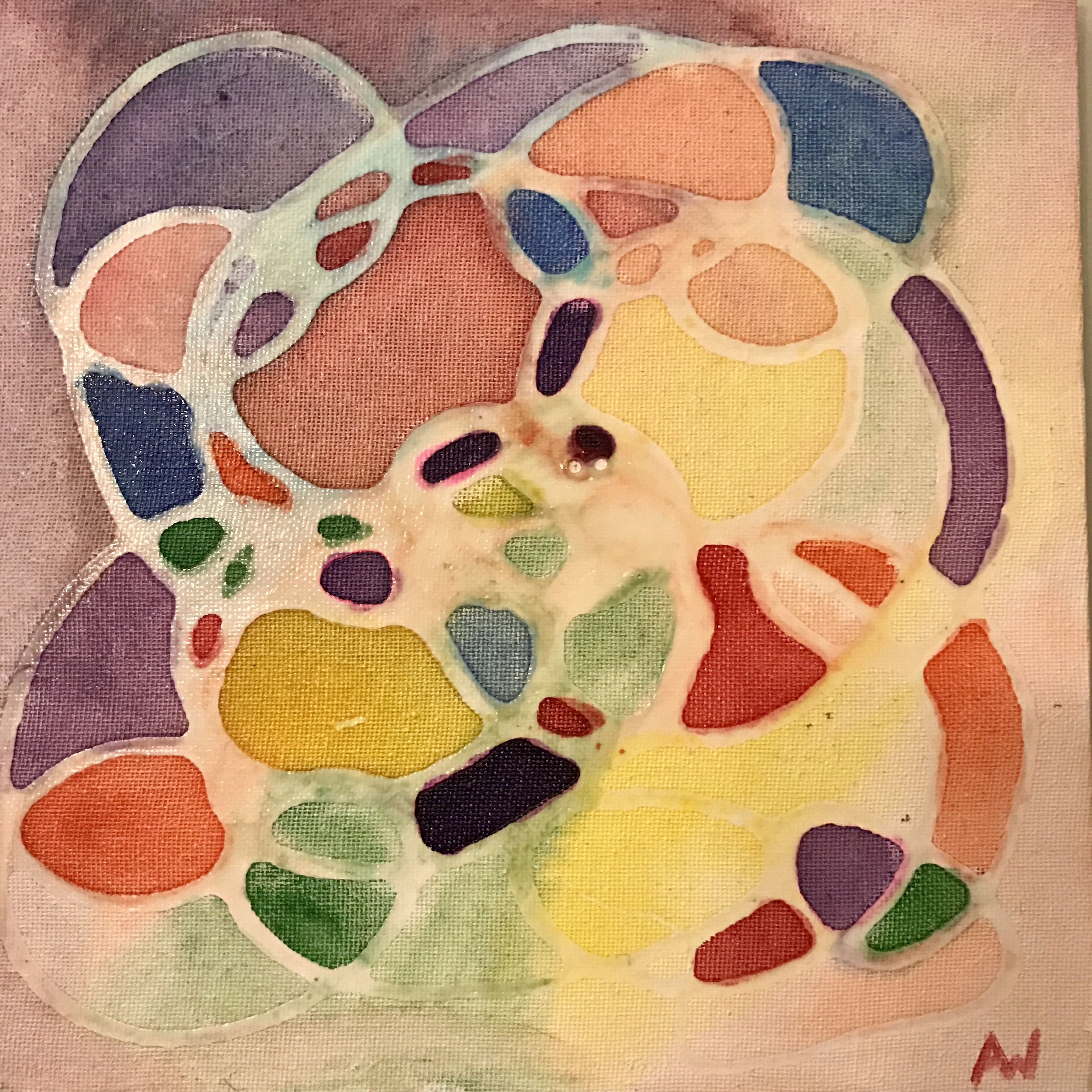
 This started out as a watercolor project with the tiny human that didn’t work the way I expected. I still like the end result.
Thankful
 Today I am thankful for so much. I have an incredible family; I serve an unimaginably huge and loving God; I live in a country that allows me the freedom to express my faith; I have been blessed beyond all measure; and today I can share this feast with a blessing I thought would never be possible and still takes my breath away.
Biased
I am a middle-class white Christian woman living in Alabama. I am not looking to add to the chaos and clamor surrounding every discussion of race I have heard in the country and in my state for the last two years. I certainly have no wiser words to add than have already been said. We have provable systemic problems that need to be corrected. We have men and women in police uniforms being targeted and maligned for the actions of a few bad actors. We have men and women of color who are right to point out that there is inherent discrimination, and they are right to fear the “system” as it exists. I only want to add an admission to this discussion that bias exists, and it isn’t the same as racism.
How do I know this (besides the hundreds of well-researched studies and papers about this very topic)? Because I saw it in my own thought process this week. Having jumped back on the writing wagon with both feet, I have been working on a book about processing grief, and I’m plotting a novel to write after I finish the grief project. In my free brain time, like commuting, I have been dreaming up characters and mapping the town for my novel; I imagine their faces, and I give them personalities and quirks and voices. I was running through my cast of characters a few days ago, and this realization slapped me into rethinking my characters: everyone I had imagined was white. Every. Single. One.
I imagined a world that I limited without even realizing it. I restricted the beauty available to my made up world by unwittingly restricting it to a single color. That certainly doesn’t reflect my life – I have a workplace and professional network full of vibrant and diverse people; I have served and socialized with and taught people from all over the world; and I have people I consider family whose skin is very different from mine. But I failed to incorporate that into any of my major characters, not because I am racist but because I am biased. I based many of the basics about my characters on family and people I have known in similar towns, and most of my family is white. That is what I naturally imagined first, which isn’t inherently bad or wrong, but it does reflect my natural bias.
Bias isn’t inherently bad, either, but unchecked and unexamined, it becomes racism or sexism or any other ism out there. I am not advocating for any particular activism or group here. I think it’s wonderful to be part of a group that is helping people, but I also believe activism happens best on a personal basis. I can only control my own thoughts and actions, and I have limited influence on anyone else’s thoughts and actions. I have seen every side of the current political system try to shout the other side down, and I have seen them fail to persuade the masses outside their own party to fall in line with their thinking. For what it’s worth, I think both major parties are wrong right now. And I think both sides are hurting right now over the election results and the responses to it. As a nation we aren’t seeing past our biases.
My only goal in sharing this is to encourage you to closely examine your own biases and to share them honestly with someone once you see them for what they are. If you are like the majority of the country, you aren’t racist, but you might be filtering the news and politics through a biased lens. I work hard to find news reports from every angle to break up the echo chamber that’s so easy to fall into on social media and by sticking to a single source for news. I try to empathize with every side in a story and to wait for facts before choosing a side. In spite of this effort, I realized I am still biased. I say this with no shame and no guilt, but I also know that I must be vigilant to see things from the perspective of “other.” No matter what category your race or gender or age or anything else puts you in, you are implicitly biased; it appears to be a fact of human nature to seek out same and avoid other.
We all just have to work hard to love other as much as we love same. It’s as easy and as impossible as that.
Winging It
My life most always feels like some terribly planned improvisational film experiment; I am enough of a type A personality to want things to be done perfectly but not enough type A to get it all done, much less perfectly. I am a lister – I make lists of things to do, things to pack, crafts to finish, things I want to write about, things I’d like to draw, stuff to donate, stuff to organize… Lists are my way of sorting the chaos in my brain and feeling like I have some level of control. Sometimes they feel like a quantifiable measure of the success or failure of my day – more things marked off, good; not enough things marked off, bad. I usually sit down at the beginning of the week and plan out each day’s list from the Master List of Things I Hope to Complete Before I Die or Jesus Comes Back.
Having a plan makes me feel settled, even if I know I will only ever do about half of what I wanted to accomplish. Most of the time, though, I am just desperately winging it. Somehow over the last few weeks in my Bible reading, verses about God’s Plan from before the Beginning of Time (that’s a much more impressive list title than mine…) keep cropping up. Exhibit A: “For God saved us and called us to live a holy life. He did this, not because we deserved it, but because this was his plan from before the beginning of time – to show us his grace through Christ Jesus.” 2 Timothy 1:9 NLT
We humans tend to crave direction and attempt to discover God’s plan for our lives, and maybe especially because of the pain and loss I’ve experienced, my eyes are glued to passages about God’s plan. I want desperately to know that what I’m dealing with has meaning. Exhibit A sums up the plan: to show us his grace through Christ Jesus. This verse makes it abundantly clear that the death and resurrection of Jesus was God’s plan all along, not just a backup plan when Mosaic law failed to perfect us. Maybe I’m alone in this, but a lot of the ways that I was taught about the Old Testament made it feel like merely prologue or cultural and historical context for Jesus, like a failed experiment in making people right with a system of laws and sacrifice until Jesus came. Paul makes it plain to Timothy that Jesus was always the plan – even in the Old Testament. The law serves to show us our imperfections and to point us to the only one who can make us whole and right.
So maybe in literary terms this makes the Old Testament a prologue to grace, but that’s a pretty shallow interpretation. Throughout the books of the Old Testament, there are stories of God’s grace and redemption (Hello, Abraham, Jacob, Samson, and David to name a very few!). Hebrews tells us that everyone who followed God in faith even before Jesus was revealed was redeemed as part of the plan. God’s grace has always been the plan.
How does this translate to my need for a daily plan and my desire to know that all of the crap in my life means something? The short answer is it means that my lists and my purpose boil down to two things: to know God and to make him known. Yes, I have work to do that doesn’t feel like it matters in the grand scheme of God’s Plan from before the Beginning of Time, but my obedience and my work signal my obedience to God and (when I get it right) show a God of order and (when I get it wrong) show a God of grace and new chances. In my daily life, it also means that my plans are temporal, so when God puts something eternal before me, it trumps my to-do list every time. By eternal things, I mean conversations that encourage family or friends, opportunities to help someone in need, moments to just sit down and be with my husband and daughter, time spent praying and studying God’s word.
In the long-term view, my purpose on earth is always just to know God and to make him known. That’s the only answer that matters. Of course, I want to know that I had ten miscarriages for some more noble reason – that my story of struggle comforted hundreds of thousands of women and inspired them to bravely move forward. That is my human pride wanting to feel important and justified here on earth. The truth is, it’s malarkey. I know that I have occasionally written some words that have helped someone else, and I wouldn’t be writing this blog had I not needed an outlet. I have been in a position to comfort others and to offer some advice for those trying to comfort a loved one. Those things matter, but only in the context of the big picture. I have seen God’s grace in my struggle, and I have done my best to share that. Knowing the metrics of how that has specifically impacted the world is pretty much just keeping score; it demeans God’s Plan from before the Beginning of Time by putting it in my human grasp.
Here’s the thing about knowing that God has a Plan from before the Beginning of Time and that I have my miniscule role to play within it: sometimes this just pisses me off. There’s no gentler way to say that. If I think about me as the center of that plan, I get angry that there was no better way in my life to know God or to make him known other than to experience ten miscarriages. Really? One or two wouldn’t suffice? The only answer to that rage and frustration is to know that my only reason for anything is to find Christ in the midst of it and to cling to his grace. Something we often gloss over in Christianity is that Jesus was both fully God and fully man. It’s easy to imagine God being perfect and being a perfect sacrifice; it’s really hard to imagine a fully human brain willing to die a horribly painful death. We all have internal dialogue – what must the conversation in Jesus’s head have sounded like when he thought about God’s Plan from before the Beginning of Time? Really? This is the only way to accomplish your plan? But fully human Jesus stuck to the plan anyway and radically changed the perspective from which we all should view our plans.
Know these two things wherever you are today: Jesus has been where you are, and God never wings it.
How’s Your Grumpy?
Last month I had a week full of the common aches and pains of life – a pulled muscle, a migraine, mild insomnia, achy knees… And I was grumpy. So very grumpy. By that Wednesday I figured I had logged at least ten hours in the kitchen over a three day span; I had picked up the house at least four times (because I’ve been on a mission to keep the house in better order, even though no one else is…), and I was tired and feeling funky. I’m sure hormones were a factor in the funk, but mostly it was a week that I spent taking care of the house and everyone else while ignoring basic self-care.
I was focused on the to-do list and not doing things that I need to maintain a little bit of sanity, like exercise, writing, and crafting with the tiny human. I plopped down on the bed and exhaled all of that grumpy as one long huffy sigh, and my husband asked, “What’s wrong?” Every time he asks this question, all of the things run through my head in an incoherent stream of consciousness jumble, and I want to say, “Everything. Everything is wrong,” as I try to list all of the mess in my head. But I pause to inhale and let the inner dialogue slow just enough to form a coherent sentence. “My head hurts; that muscle in my back is still sore. I’m tired because I haven’t slept well in a week, and I’m very grumpy.”
I would love to tell you that identifying the actual problems made me realize I should slow down and take better care of myself. That night I tried to go to bed earlier, and I felt better physically the next morning. Before we got up, my husband ran through a checklist. “How’s your back?”
“Mostly better, but still a little sore.”
“How’s your head?”
“Better.”
“How’s your grumpy?”
My grumpy was still going strong. Knowing that it was at least partially a hormone cycle issue made it easier to work through because I could tell myself there was a clear end in sight, but I had to focus on ungrumpification for a few days. Maybe I will always fight depression. Maybe all of us feel bouts of mild depression, and I’m more aware now when it happens to me. But my new found power of awareness is useless if I don’t take better, healthier steps to address my grumpy when it happens. With great power comes great responsibility. And we are responsible for taking care of ourselves, too.
It’s easy to forget when we are faced with taking care of family, taking care of work, taking care of home… I cycle through great periods of self-care and then long droughts. I struggle to fit everything I need and want to do in a day, so I let the “non-essentials” slide. Those things are what keep me healthy and strong, though, so they really are essentials if I want to keep my grumpy in check and stay productive. I’m working harder to keep the essentials prioritized so that I can tackle the task list without resenting the largely thankless work of housekeeping and parenting and work. It’s a work in progress; I think it will be a lifetime job.
How’s your grumpy? If it’s running amok, check in with yourself, and be honest with yourself about what you are doing to stay healthy mentally, emotionally, and physically. If you don’t have a single thing in your daily to-do list that strengthens your body and your soul, add something and do it first. I have learned that I will never exercise at night if I skipped it in the morning, so I have to do it in the morning. Same thing with Bible study and prayer time. Guess what the first two things in my morning routine are now? If you’re struggling to make that happen, find a friend to check in with who will lovingly hold you accountable for taking care of yourself. I have two such wonderful women in my life, and I trust them to tell me truth even when I don’t want to hear it and make excuses. I rely on their encouragement, and I try to be the same type of friend for them.
If you’re struggling to find a friend to trust, please let me know. Maybe we need to form a support group for grumpies. Find a way to keep your grumpy from controlling your days, and don’t do it alone. You are a precious Child of God, and he made you to be full of life and abiding joy. If you don’t feel full of life and joy more days than not (not all days will feel like that – crap happens to everyone), then your grumpy may be in charge. Don’t let it win. You are not your grumpy. You are beautiful and valuable and worth taking care of.
Dear Child, You Are
You, dear child, are a flower –
A dazzling concoction of scent and hue,
Deeply passionate as a rose,
Bright and full as a hydrangea.
You will one day be a tree
With deep roots, strong arms,
And comforting shade –
A blessing to all you shelter.
You will always be a river –
Continuously changing and flowing
Past obstacles, through time,
Until you reach the sea.
Above all, dear child, be the sun.
Spread light. Give life.
Have joy. Speak truth.
Shatter the darkness with love.
Freeform Friday
 Fun with acrylics.
Tell Me I Was Good Today
Most nights, I lie down with Engelberta in her bed, and we read a few books before I turn the lights out. Then we lay there in the dark, and I have to tell her “Be still and be quiet” at least a gazillion times while she squirms and talks and performs daring feats of flexibility. I will pat her back or rub her face while I tell her things I love about her or things that were fun to do together that day. Occasionally I skip this step in our “FOR THE LOVE OF ALL THAT IS HOLY, GO TO SLEEP BEFORE WE BOTH DIE” routine. Engelberta is quick to remind me, “Mommy, you forgot to tell me how good I was today.”
Even if it was a terrible day, even if I am sad and exhausted beyond words, even if I am mad she won’t go to sleep, I will find something good to tell this tiny human. I am far from a perfect parent, but this is one thing I can get right; I can always tell her that I love her just for being her, and she needs to know that I love every moment I spend with her (whether I enjoy them all or not). She needs to know that she is good and loved and valuable and precious, and I need to take every opportunity to fill her up with good and kind words. Because the world will whisper the opposite. Because sometimes I yell when I’m mad at her. Because no matter how much I want to shield her, terrible things are going to happen in her life.
Because I think we all need to hear wonderful words whispered to us before bedtime. I know I do. I thrive on words of affirmation; it’s the love language I respond to best. If I were to sum up my life’s goals, they boil down to three things: to know God, to make him known, and to hear, “Well done, good and faithful servant,” when I get to heaven. Every single thing I do, every role I inhabit falls into at least one of those summary statements.
Some days, knowing that I have done well even when no one else recognizes it is enough because I know that God saw it. Some days I struggle through the thankless tasks of cleaning the never ending dirty dishes, picking up all of the things from all of the places they land, dressing a squirrely tiny human who would much rather be dancing naked… I want desperately for someone to pat my back and tell me how good I was today. I want someone to acknowledge that I worked hard, and I what I did was enough. Most of the time I unfairly expect my husband to fill this void. I’m not saying he should never encourage me, but it is not his job to make me a whole and fulfilled person.
When I am struggling for affirmation, I am struggling with my value as a person and as a child of God. As a person who also fights depression, this is an uphill battle. I have a few coping tools to pat myself on the back and tell myself I was good today. I look back over the day and acknowledge what I got done or a special moment or something that made me laugh, and I try to keep all thoughts of what’s left on my to-do list at bay until the next morning. I keep a few special notes that people have given me over the years so that one exceptionally bad days I can remind myself of nice things people have told me about myself. I take a break and do something that makes me happy for at least a few minutes, like crocheting or a hot bath or reading a good book. And, probably most importantly, I try to encourage other people.
Specifically, I work hard to build up the women around me because I know we all have an inner critic that doesn’t stop for much. Women particularly struggle not to compare themselves with other women, and we tend to think we can just work harder to be perfect. Men tend not to have the unending inner voice; I used to think my husband was lying whenever I asked what he was thinking and he said, “Nothing.” I’m taking that response on faith, because it’s never quiet in my brain, and I know I’m not the only woman with a brain that veers too often into the weeds of criticism. I do what I can to encourage other women, so maybe together we can keep each other out of the weeds. I’ve also learned that when I work harder to see something good to encourage in someone else, I look past their faults. If I can look past someone else’s faults, I can extend myself the same grace; it’s not always easy, but it’s definitely a skill I’m improving.
Do you have some good coping tools when you need affirmation? Do you have at least one friend you can trust to be honest with about your needs and who will lift you up when you need it? What actions do you need to take to develop a coping toolbox and at least one solid friend? If you’re struggling with that and need some help getting started, please e-mail me at mabbatblog@gmail.com. When you’re bogged down in the thankless daily grind, remember before you go to sleep to pat yourself on the back and tell yourself, “You did good today.” And don’t forget to affirm someone else; we are all tiny humans at heart who need to be filled up with good and encouraging words.
Invisible Made Visible
Invisible made visible;
Impossible and unimaginable
Sprung to life and speaking,
Writing volumes of theology
About the Creator –
Words scholars have yet to discover.
Step out into the Word,
Into the God-breathed world
Of constellations and forests,
Living creatures and changing seasons.
View his eternal power, his divinity,
His immutable law.
Clap along with ocean waves,
Shout as loud as the rocks,
And skip with the mountains for joy.
To Bear Witness
I love the Coffee and Sweatpants Facebook feed. One of the illustrations posted last week said that if someone can live through something awful, you can at least bear witness. (This is an unartful paraphrase, so go web search Coffee and Sweatpants.) This idea has stuck with me since I saw it, and it reminds me of Job declaring that his redeemer would stand and recount his deeds, and he would be justified. I think this is what funerals are all about.
We gather to publicly mark the passing of a life, to bear witness to the agony of the loved ones left behind. We tell ourselves that we are comforting them with our food and our presence, and maybe we are. But our words fall hollow in a mourner’s ears; nothing we say is going to heal their broken heart. We can only bear witness to the tragedy and simply be present.
Death isn’t the sole cause of grief, so we must be present enough in our loved ones’ lives to observe the invisible losses that trigger a shower of casseroles and floral arrangements. Bear witness. Be there. “Share each other’s burdens, and in this way obey the law of Christ.” – Galatians 6:2
What does it look like to bear witness? I don’t know. I conjure mental images of the chorus in a Greek tragedy, but this seems wholly impractical and loud. As a practice in my life, I try to be what I needed when I was trying to cope with loss, but I also try to temper that with what I know of the person. If you are crying, I will most likely hug your stuffings out because when I cry, I want to be wrapped up and held. If I have never met you or don’t know you well enough to squish your guts out, I will go for the side hug and rub or pat your back until you can at least form sentences. I will not leave you until you tell me to go away or I know that you are feeling at least a tiny bit better, even if it’s awkward. I excel at awkward.
Bearing witness can be as simple as merely acknowledging what someone is feeling and validating their experience. “I’m sorry you are experiencing this. I know that you are feeling sad/angry/depressed. I’m here if you need to talk.” That’s it. Nothing fancy – just sincere acknowledgement that sometimes life sucks and we don’t know why. And then listen without interrupting when someone shares their pain with you.
You can’t fix it, and you won’t say any magic words that will take away the pain. We so often want to say beautiful words as a balm for wounded souls, but in my experience receiving those attempts, they generally aren’t helpful. So many of the “churchy” phrases we offer come out sounding judgmental or hurtful, even though our intentions are pure. To bear witness is not to testify, so be simple and kind: “I love you. I’m sorry this is happening to you.” If words are not your thing, offer a hug or a cup of coffee or a casserole; food is a bona fide love language in the South. Bottom line: be the witness you wish you had when you were experiencing tragedy.
 Mabbat