Patience

I say quite often that patience is not my strong suit. I won’t say that anymore. There is a long-standing “joke” among Christians that you should never pray for patience because God will give you opportunities to use it. Ask any group at any church what happened when they asked God to give them patience; they didn’t suddenly, mystically reach such a zen-like state that Buddhist monks were jealous and asking for pointers – they encountered circumstance after circumstance that tried their patience – a baptism by fire, if you will. We silly humans expect that if we pray for peace or patience that this brilliant light accompanied by an angelic “ah” chord will signal to us that we have received the requested virtue. God, on the other hand, likes for us to experience firsthand the results of said requested virtue by putting it into practice – usually immediately.

It has taken me years to accept peace and patience from God, but this last month has proven that I am finally getting it through my thick skull. We had a follow-up appointment last week with the fertility specialist. I was expecting him to say something along the lines of “your egg quality isn’t very good, so we just can’t expect a better outcome in the future.” I had been bargaining with God for an if, then result – a clean answer to move on and give up trying ever again to carry my own child. Even though my husband and I had carefully avoided discussing possible courses of action until we went to this visit, I was fully expecting to hear that we were done pursuing this route. As much as I had told myself that it would be a good answer – a definitive directive to go forth and adopt – I couldn’t deal with the thought of never, ever having a successful pregnancy, of never, ever having those special moments with my husband of feeling the baby kick or seeing our baby on an ultrasound picture while we both pretended we knew exactly what we were seeing in the grainy picture on the monitor. So, I put all thinking on pause for a few weeks until we went for the follow-up, knowing that after that visit, my soul would be crushed, and I would grieve more for the loss of that dream than for the loss of our last pregnancy.

In retrospect, I should have known from our medical history to date that there would be no such clean answer. Our doctor still has no idea why we can’t maintain a pregnancy, and he has recommended a second opinion visit with another doctor. As the doctor said, he feels like we’ve done everything we can to determine what the problem is, but for our sake he hopes another pair of eyes will find the magic bullet. I’m sure that for a doctor it’s hard to hope that you were wrong and that another doctor will solve the problem, even when you’re sure you’ve done everything in your power and doubt that there can be any other answer. That’s humility and love, and that’s why this entire doctor’s staff is so great at what they do.

Obviously, patience and peace have been two of the things I have begged God to give me, and I know that he has because of my response to last week’s news. We still have no indication that there is actually a problem, and we’re going to see another doctor who will not likely have anything to add to that statement. I’ve been waiting for that lack of knowledge to send me into a raging bull state of mind, but I’ve been surprisingly settled with the lack of answers. It felt like mercy to find that although I may not be able to carry a child for no apparent reason, the dream isn’t dead. We had already decided to table any further action, whether it’s IVF or just trying again or adopting, until at least the fall, so this doesn’t change that decision to pause for a while. We’ll go to the new doctor in a few weeks, and we’re investigating adoption agencies and options. We’ll wait, and we’ll know that we have the peace and patience to wait calmly and expectantly for God to direct our next steps.

The Christian View of IVF

The title is an intentional misnomer. There is no one Christian view of IVF, and there won’t be until Jesus returns. As a Christian and an IVF patient, I’ve had to navigate a LOT of rhetoric and conflicting viewpoints to establish my own beliefs about IVF. If you google the phrase “Christian view of IVF,” you will find a plethora of opinions that are loosely, if at all, based on the Bible. Most of the opinions are based on statistics and bad biology. I have been thinking for months about whether to share what I believe and how to share it in a way that would make sense and hopefully encourage some of you who may agree with the Pope’s position that IVF is a “grave evil” to dig a little deeper. I think the most sensical way is to organize this as a statement of common opinions followed by a rebuttal, so here goes, and be warned this is a lot longer than most of what I post.

Opinion: IVF is unacceptable because some embryos will be destroyed or will not survive the process, and any unused embryos may be frozen indefinitely or destroyed. The only thing these unused embryos need is nourishment to grow into full-term babies.

I thought I’d tackle the toughest one first, and I know this is the one point that will alienate more than a few personhood amendment followers. I believe that some form of life begins at conception; I do not believe human life can form until it is implanted in the uterus. I also believe that you cannot form an opinion about this without studying the biological as well as the biblical basis for this. If all an embryo needs is nourishment to become a full-term baby, then it would not necessarily need a womb; science can’t reproduce the effect that implantation has on an embryo. Obviously, that is a necessary step in creating human life beyond the cellular life form of an un-implanted embryo. Read very clearly here that I do not agree with abortion; once an embryo has been implanted, it should stay there. That’s a whole other topic, so that’s all I will say. The biblical basis for claiming that life begins at conception, end of story, is usually Psalm 139:13 that says, “You formed my inward parts and knit me together in my mother’s womb.” Other oft-quoted verses are Job 31:15, Psalm 22:9-10, Isaiah 44:2, and Isaiah 44:24, all of which describe a person being formed in the womb. I don’t disagree that life begins in the womb, and you’ll have a tough time proving anything more specific than that with the Bible. As eternal beings, conception as the beginning point of human life might also be an arbitrary biological point on the timeline; Jeremiah 1:5 and Psalm 139:16 both speak of being known by God as a person before any biological beginning – “before I formed you in your mother’s womb” and “every moment was laid out before a single day had passed” both imply that we are eternal beings that God created and knows intimately, both before and after our earthly life span. I realize that this may seem inconsistent with the thought that biological human life begins at implantation, but, then again, this view makes conception just as arbitrary a point for creating laws and moral codes to protect unborn children.
As far as the embryos that don’t survive, here is the biological fact to consider: this happens all the time in nature. I don’t know if there is data with an approximate number, but over the reproductive lifespan of a married woman, there are easily dozens of eggs that become fertilized but do not for some reason implant. When that happens, the woman’s body doesn’t respond to the fertilized egg/embryo as a pregnancy. The embryo is wasted in the menstrual cycle. No one bewails the loss of these embryos because no one ever knew of their existence. The embryos that don’t survive IVF are representative of that many naturally wasted embryos. A woman is born with a certain number of eggs and no more. The only difference in those eggs becoming naturally occurring embryo losses over a time span of months and those embryos being lost via IVF procedure is that more eggs are fertilized at one time and we can know exactly how many there were. If three embryos are lost in IVF, it represents three failed months of attempting pregnancy without intervention and three embryos that would not have survived in the womb had they been traditionally conceived. As for the embryos that are not used, every couple has to decide what to do based on their situation and beliefs. I personally find that freezing them for an indefinite period is wrong. If you view those embryos as human lives, and you leave them on ice forever, how is that different from leaving a loved one on life support in a brain-dead state until they die of old age or opportunistic disease? Where most Christians would not have any moral objection to the termination of extreme life support or to DNR orders, many are content to leave embryos frozen interminably so they don’t have to confront the problem of what to do with them.

Opinion: IVF is unacceptable because it only has a 20% success rate; no one should willingly risk the life of a child with those odds.

This statistical argument angers me on many levels. According to this line of thought, I should be sterilized since I have a less than 10% chance of a successful outcome without intervention solely based on the number of miscarriages we’ve had. For me to get pregnant naturally or otherwise would be child endangerment. Of course, the problem with this argument is that it doesn’t take a rational view of any other statistics, like those surrounding miscarriage. It is estimated that 20% of all diagnosed pregnancies end in miscarriage and perhaps as many as 50% of all pregnancies end in miscarriage when very early unknown pregnancies are included (this stat came from the March of Dimes, but you’ll see it a lot if you research miscarriage very much). If a naturally occurring pregnancy has a 1 in 5 chance of failing, possibly even as high as a 1 in 2 chance of failing, why aren’t we berating all women for getting pregnant and risking these innocent lives? Again, we’re willing to assume some risk and loss in nature but not from science.

Opinion: IVF is tantamount to cloning, gene manipulation and genetic selection.

I have seen more than one opinion piece claim that couples can choose the gender of the eggs that are implanted, and we are only days away from genetic screening that would allow couples to choose more desirable traits and not transfer the embryos that may have less desirable qualities. Maybe there are labs that do this. Our doctor has yet to offer or guarantee that we could choose the gender of the embryos we transfer, and the genetic testing to make this guarantee risks damaging the embryo, which I’d guess is why our doctor hasn’t even mentioned this option. There is a bit of selection that occurs before transfer: every doctor I’ve ever heard of chooses the strongest looking, most well developed embryos for transfer to have the best chance of those embryos being able to implant themselves once they make it to the womb. Couples are generally screened for genetic abnormalities that could cause life endangering genetic birth defects for which their offspring might be at risk before any doctor will proceed with IVF. That allows doctors to know if there’s a genetic reason for recurrent miscarriages or infertility, and it allows couples to choose whether or not to proceed if they could pass on a risky gene, all without creating embryos to test. I’m sure that there are and will be doctors in the future who will manipulate the genetics. I do agree that this practice is wrong, and as a patient the only way to avoid this and ensure that you are not supporting doctors who encourage genetic manipulation is to do your homework before you choose a doctor and to report any abuses you see. I’m not sure how and where to draw all the lines, and the ethics of cloning and gene manipulation have been hotly debated in the scientific community for decades.

Opinion: Couples who choose IVF are “tinkering” with God’s work in the process of having children. Maybe these unnaturally conceived children were never meant to be born.

I invite anyone who holds this opinion to reevaluate their use of modern medical procedures and then come back to the discussion. We accept medical tinkering all the time in the form of medicine, surgery, respirators… The list is longer than ever before in history. If you have no problem with organ transplants or pacemakers or insulin pumps, I think your logic is inconsistent if you disagree with infertility treatments on “tinkering” grounds. And you’ve also limited God by stating that children conceived through infertility treatments were never meant to be born. Either God is all-powerful or he’s not. Do you really think God would allow the birth of a child he couldn’t love or use to glorify him? I suppose this opens the free will versus predestination argument, but I don’t think it’s a terribly important topic for anyone to spend a lot of time on. Either God is omniscient, omnipresent and omnipotent, or he’s not. End of discussion. 😉

Opinion: Perhaps infertility issues are a sign from God that the couple should adopt. There is too much emphasis placed on having biological children, especially when there are so many orphans who need homes.

Malarky. I would no more try to tell someone, friend or stranger, that their present difficulties were a sign from God unless God directly told me to. We don’t go around telling cancer patients that breast cancer is a sign from God to eat more broccoli and never miss a screening test. God certainly sends us signs, but there is no biblical basis for telling anyone that God is telling them to adopt just because they are dealing with infertility. The most often quoted passages about being patient through infertility are about Sarah and Isaac (read Genesis) and about Hannah and Elkanah (read Samuel) and neither passage speaks of either couple adopting as a means of fulfilling God’s promise to give them children. Sarah took matters into her own hands as her future granddaughters-in-law would also do, and Hannah waited for God to intervene on her behalf, but both gave birth to their promised children. God does give us signs, and sometimes he uses other people to show them to us, but resist judging the signs you think you see in someone else’s life unless you feel God leading you to point them out. You have no idea what God has put into the hearts of a couple struggling with infertility, and we’ve usually considered and prayed about every option you’re going to throw in our faces. If you’re still sure that we as a society are placing too much emphasis on biological children, consider this verse in the New Testament: “But women will be saved through childbearing—if they continue in faith, love and holiness with propriety.” 1 Timothy 2:15. I have yet to hear a decent answer about why this verse is even in the Bible if we are all saved through faith. As a Christian woman, how am I supposed to interpret this in my life? Do eight (now nine, actually) consecutive miscarriages imply that I am not able to be saved? Personally, I find this verse extremely difficult to live with because it only speaks judgment to me. Men tend to skip this one because it doesn’t really apply to them, and they can’t understand the female perspective of this idea. Trust me men, there are a lot of hurdles presented to women in this single sentence, the least of which is a direct emphasis on biological children.

Opinion: IVF is an expensive procedure, and the couple would be better off not wasting their money on something that may or may not work; they should spend that money on adoption since it’s a sure thing.

IVF is expensive, but adoption costs just as much or more unless you manage a private adoption that doesn’t require any agency assistance. Since most adoptions go through an agency, most adoptions cost more than IVF. Some couples have insurance coverage for IVF and other infertility treatments, reducing their cost. And adoption may be more of a sure thing statistically than IVF, but it is not a guaranteed sure thing. All of us must be good stewards of the money God entrusts us with, so all of us have to make these decisions based on our financial status. We all have to make responsible decisions, and I agree that it is irresponsible to spend so much on IVF or any other infertility treatment that you have nothing left or are facing extreme debt. We’ll be facing a decision point soon about whether to begin the adoption process or whether to give IVF one more shot. No matter what we do, we have to make sure that our financial house is in order before proceeding.

The bottom line is this: we are all human, and none of us has a complete grasp on the will of God at every moment; we pray, and we seek counsel, and we make the best decision we can based on the direction we think God is leading us. If you think that anyone, especially a Christian, lightly makes the decision to try IVF, you’d better keep thinking. If you as a Christian feel that IVF is morally wrong, then you should not ever under any circumstances do it. If you feel that God is leading you in any direction, you’d better follow, whether it’s IVF or serving the homeless or sharing your faith with strangers. Go where God has prepared for you to go, and you’ll be walking in the right direction. Don’t go, or run the other way, and God will bring you back (maybe in the belly of a giant fish…) to where he wants you to be. In the meantime, if you feel tempted to tell someone going through IVF that they are a murderer or perpetrating a great evil, stop. This tactic will not work unless you are a proven and inerrant prophet. If you really feel led to confront someone, you should speak from love and not the hateful words that fill out so much of the rhetoric surrounding IVF and other fertility treatments. And, if you feel that you should confront me, tread lightly and lovingly; I have had lots of time to pray about what I believe and about our current course of action, and my b.s. rhetoric meter is pretty sensitive.

My conscience is clear, but that doesn’t prove I’m right. It is the Lord himself who will examine me and decide. (1 Corinthians 4:4 NLT)

“The Healing Power of Spit”

Jesus once healed a blind man

with spit

and dirt.

Theologians teach that this was a sign

of humility

and surrender.

Maybe so.

Or maybe my dog is right, and it’s a sign

of love

and acceptance –

The healing power of grace expressed

with intimacy

and immediacy.

I wonder.

Maybe the sole purpose of my dog’s tongue is to remind me

of gentleness

and mercy

And the healing properties of spit when properly applied

with love

and just enough dirt.

*A little note about this post: The poem was inspired by our German shepherd, Brook, who refuses to let me cry alone.  If she hears a sniffle or smells a tear about to drop, she comes to wherever I am and sits with me.  Sometimes she actually tries to lick the tears off my face, and she always sits close enough to rest her head on my shoulder or lap.  The photo is an old picture of Bear eating a candied apple, which really has nothing to do with the poem except that it’s the best dog tongue picture I’ve got.

Signs and Wonders

Yesterday was obviously a difficult day; after a week of waiting, we found out that our suspicions were correct and our pregnancy had not continued. One thing I always question God about in this situation is why he doesn’t perform a miracle for me. It’s selfish and a little silly to compare what God is doing in my life with other people who have had miraculous intervention that saved their baby when the pregnancy was endangered. But it’s a hard pill to swallow if I look at it too long from my human perspective without considering that I can’t see the bigger picture of what he’s doing through our losses.
Here are the miracles that did happen yesterday: two people separately and specifically prayed that
God would be enough to sustain me and my husband through this loss; a whole mass of people sent us love and support and prayers through messages and phone calls; we were directly loved by God through an amazing network of family and friends who will continue to hold us up with prayer and physical comfort through the next weeks and months. We have been the body of Christ supporting others, and now we are receiving the support of the body of Christ.
God could have performed a miracle and continued our pregnancy, and he would have received glory from that. It would have been a great story. But what’s the better story? Which ending gives more glory to God? I don’t know, but I am grateful to be able to see that his love being expressed through dozens of people is also a miracle that not everyone will experience. Any loss can be isolating, and miscarriage tends to be even more so because people don’t share it or family and friends feel uncomfortable discussing it. We have the blessing of feeling the wagons circling around us and isolating us from the loneliness instead of the other way around.
I heard more than once yesterday that I should be a bigger mess than I am because of this pregnancy loss and because of the sheer volume of our losses. There are two reasons I haven’t fallen apart yet. Right now the news, even though expected, doesn’t feel real; it will become real and painful soon enough. And, I can confidently say that I have faith that will sustain me, and I have the love of Christ expressed in so many ways in my life that I have no reason to fall apart. This walk would be impossible without that knowledge; logic alone would give me the right to give in to the self-pity and depression. Faith and the sacrificial love of Christ demand and empower me to work through it (trust me, there will be depression and anger and every other stage of grief in its time) and not let it cripple the rest of my life. The song “What Doesn’t Kill You Makes You Stronger” has been extremely popular, probably because people cling to the thought that just surviving a trial makes us stronger, better people. I won’t pretend to know enough of the words to claim that the song as a whole has any sort of biblical message, but the title certainly does. God uses our weaknesses to show his strength. When we can demonstrate his strengths rather than rely on our own, we are stronger, better people who thrive rather than just survive a trial.
While it certainly isn’t the miracle I was hoping for, God is showing us signs and wonders of a different sort. The weeks and months to come will certainly hold different perspectives for me, and most of them will not be this reasonable or faithful. Once survival mode ends later this week or next week, the even greater miracle will be continuing to seek God’s face through the pain.

Good News, Bad News, and More Waiting

So we have some good news: the pregnancy test is positive. The bad news is it’s just barely positive. The hcg level is low, which is not a good sign, but I go back for a recheck on Wednesday. To paraphrase the nurse who called, we don’t see a lot of numbers this low that work out, but we have to wait and see. I love the staff at Alabama Fertility Specialists – they do a difficult job with grace and sincere concern for their patients. That’s a rare gift for couples like us, especially if you’ve dealt with difficult circumstances like our multiple miscarriages at a regular OB/GYN office.

I’m glad to have the positive test result no matter what happens from here. Regardless of the outcome here, we’ll have a better idea how to proceed and when to change directions. Positive, no matter how faint, means that we have made every attempt medically possible to ensure a good outcome. If things don’t end with a healthy pregnancy this time, we’ll have the benefit of a great doctor’s expertise on whether to try IVF again or not, and we’ll be able to walk away from this path without any doubts. If things stay positive, then we’ll have an exciting path to walk right now. Either way, God has answered our prayers through this particular journey with a positive pregnancy test, and he’ll lead us to the next step.

I keep (sort of) joking that a positive pregnancy test is akin to Gideon’s fleece prayers (see Judges 6 – I LOVE this story!). I have been telling God that I really need a positive test no matter the end result because if it works, that’s a great and immediately answered prayer; if we still miscarry, then I’ll be content to walk away. People keep telling me stories about couples who start to adopt and then have successful pregnancies. Usually these stories are prefaced with, “They had a hard time, just like you guys…” I hate these comments with a passion that’s hard to describe. Adoption has always been an option for us, but I want to pursue it wholeheartedly, without any part of me thinking that it’s a consolation prize. Essentially, I need God to close the other doors if he’s not going to audibly tell us, “Go forth and adopt a child.” We are reaching that point, and I’m excited to see what God is up to. It has to be spectacular because he’s spent a long time preparing us. We could not have even tried IVF a few years ago – our marriage wouldn’t have weathered the added strain, and I would have been a neurotic, depressed mess before we even got potentially bad news like today’s. But we not only survived the IVF process but also grew through it: my darling husband has become an expert with a hypodermic needle, and our marriage is stronger than ever.

I would never have imagined this would be part of our story. Sometimes I think I’d like to change our story, but then I know we’d be missing out on something God designed. Waiting patiently isn’t exactly my forte, but I keep finding myself in this wait-and-see mode. We managed the first two-week wait; now we’re in for the real two-week wait in our story. And my fleece is waiting.

E Is for Embryos

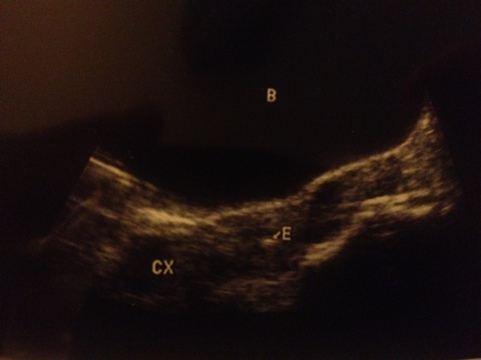
During the embryo transfer, the doctor uses a very small catheter guided by ultrasound to place the embryos inside the uterus. During our transfer, they printed a picture labeled with “B” for bladder, and “E” for embryos (actually the air bubble where the embryos are – they’re too tiny to see), and we got to keep it. I have never had a pregnancy ultrasound picture that I got to keep. All of our pictures before this one were the sorts of things doctors don’t let patients keep: empty sacs or an empty womb where a baby should be.
This picture is different; it’s actual proof that our embryos started out in the right place – proof that we have done absolutely everything in our power to have a baby that is genetically our own. This picture is worth thousands and thousands of words. Words of hope and possibility and life. This picture makes me feel like this could be the first positive step towards holding a baby of my own. It feels like a real pregnancy.
Monday is the pregnancy test, so we have less than two days left to wait. By Monday afternoon we’ll know if either (or maybe, just maybe, both) of the embryos implanted. Then in a few more weeks, maybe we’ll have another good ultrasound photo to add to the album.

20120414-233510.jpg

The Mary Perspective

For at least the last eight years, I have played the older Mary in our Easter productions at church.  Yes, I still have at least another 15-20 years before I am the same age as Mary at the time of the crucifixion, but I have makeup and stage lighting to complete the illusion.  I usually end up with this role by default since I can fake the age and I know how to direct on stage without being noticed.  The last several times I have played her, Mary has been a monologue speaking role.  No matter what the role has entailed, it has forced my view of the events surrounding the crucifixion to be colored by Mary’s view, even the Lord’s Supper that our church observed last week.

Perhaps the monologue has been the most pointed in requiring me to look at Jesus’s death as a mother and to feel the injustice that Mary must have felt.  She knew from the first announcement of the angel that this child would be destined for supernatural things, but she probably never imagined that he would be taken from her in such a cruel form of death.  Parents never want to consider that they could outlive their children; we think it violates the natural order of life.  How painful was it to watch her child be sentenced to death and then crucified?  We’ve probably all seen at least a photo of Michelangelo’s Pieta which depicts Mary holding the dead Jesus in her arms just after the crucifixion.  It’s a beautiful and moving sculpture.  To portray that moment on stage puts you inside the sculpture – inside the intense sadness and agony that Mary must have felt.

Of course she knew that he had predicted his own death, and she would know in a few days that her son had been resurrected from the dead to live forever.  But in that moment, it must have felt like the end of her own life and the beginning of something far more terrible than death: any parent who must live on after a child’s death knows that you wish you had died with them so that you wouldn’t have to face the daily pain of living without them.  This isn’t suicidal; it is a natural part of grief and a feeling you’ll face until you learn how to cope with the loss. I’m sure that once I move past this stage of loss in my life that I will see still more perspectives of the crucifixion.  Right now, I feel that Mary and I have a lot in common, and it colors every part of my Easter experience.  It doesn’t change the most important part of Easter: Jesus Christ came to earth as a human, lived a perfect and sinless life, was killed on a cross as a perfect and holy sacrifice for my sins, and then rose from the dead so that I could live in relationship with God forever.  That’s the Easter story no matter what perspective I bring to it.

And So It Begins…

We have officially commenced the two-week wait.  The clock started Monday after the egg retrieval when our eggs were fertilized.  If you’re a gory detail type, read on.  If you’re not, skip this post and try again tomorrow.  Monday, they retrieved 13 eggs, which is a good number – not too many, not too few…  A nice baker’s dozen.  The process wasn’t too bad, although it’s painful, and I’m still sore.  Of the 13 eggs, 8 were able to be fertilized and 7 developed to embryo stage.  Embryo transfer will be Thursday (tomorrow) morning.  The next big milestone after embryo transfer is the pregnancy test, which will be April 16 unless something in the schedule changes tomorrow.

In the meantime, I have enough to occupy my mind this week with Journey to the Cross.  (If you live in the Birmingham area, check out http://www.gvbc.org for more information.)  And next week, I’ll be trying to catch up with all the work I’ve missed this week.  The first two-week wait should be a breeze.  😉

The Air Down Here

These days, it’s a little hard to breathe, as if the air all around me is thick like soup.  I do live in Alabama, so there’s a pretty good chance it’s humid, which means the air is actually thicker and harder to breathe.  But there’s no difference in the air in Alabama this week from last week except that I am charging everything around me with tiny particles of nervous energy.

The ultrasound Wednesday looked good, so I have another one Friday morning to determine the exact timing of our egg retrieval.  That will happen either Sunday or Monday, and we’ll know for sure Friday after the ultrasound.  It’s a relief to think that I have two days or less left of three shots a day, even though we go right back to another daily injection after retrieval.  That one may hurt a little more, but it will be easier for me since my husband will have to administer it.  It’s a relief to know that in less than a week, we’ll be done with the “hard part” of IVF, and we’ll just be waiting to know if we have a positive pregnancy test or not.

It’s terrifying to know that we’ll spend two weeks to a month in limbo, first waiting for pregnancy test results, and then likely waiting to see if we miscarry early or not.  The entire month of April will be waiting; the whole month will be thick with the nervous energy of anticipation and worry and hope.

I occasionally troll message boards to compare situations and reactions with larger groups of women in different circumstances and from varying backgrounds and belief systems.  Most of them talk about the tension of the two-week wait (TWW for those who aren’t savvy with IVF message board shorthand).  The TWW is discussed as the most agonizing period of IVF because you can’t do anything but wait to see if it worked.  Our TWW will be a long two weeks, I’m sure, but it’s nothing compared to the TWW that comes after.  Our TWW agony will not be waiting for a positive test result (I’d be surprised if we didn’t get pregnant); it will be waiting another two weeks to see if the hcg levels double like they should – to see if we will actually have a baby with a heartbeat that will stick around longer than two weeks.

I am mentally in a good head space, and spiritually I am standing firm on my rock and trusting the outcome of both TWWs to God.  I am as sane as anyone in this situation can be, but I still have moments when it’s hard to breathe such thick air.

Fearful Symmetry

There is a lot of fearful symmetry happening with this run at pregnancy.  April 1 is our penciled in date for egg retrieval; April 1 was our first baby’s due date.  May 13 is my birthday; May 13 is also Mother’s Day this year, and by that date we’ll hopefully be almost 8 weeks pregnant.  Should we succeed at IVF, our probable due date will be right around Christmas, which tends to be hard enough to survive without thinking about what should have been delivered should it not work out.  I know, that’s a lot of shoulds for one sentence, especially in a post referencing Blake.

I am trying to avoid recalling those fearful bits of symmetry, and I am mostly succeeding.  Although, it’s funny to hear people’s reactions to finding out those bits because they all want to say something like, “Oh, that’s a good sign” or “Oooh – It’s meant to be this time.”  As opposed to every other time you’ve said that?!?  So, it’s a little hilarious in a dark and twisted way to wind that one up and watch it go.  I think people forget that they’ve already tried to be harbingers of good news, so they just keep saying ridiculous things like, “I know this timeGod is going to give you a baby” instead of, “God is in control all the time, even when we don’t understand it.”  I know a lot of really terrible prophets. 😉

Sidebar (and Nerd-Alert): If you’ve never read William Blake’s “The Tyger,” Google it and read it.  If you’re a fan of Blake but you’ve never read more about his life and philosophy than is presented in Norton’s Anthology, dig a little deeper, and Blake will be even more fun to read.