Stage Fright

This last week presented an odd combination of stage fright scenarios for me.  Oddly, the things that used to scare me no longer bother me at all, and the things I used to do without breaking a sweat tied me up in knots this week.  As long as I can remember, I have been on stage, back stage, building the stage – you name a preposition that goes with stage, and I’ve probably been there as a dancer, a singer, an actor or a techie.  All through my childhood and into high school, I was a dancer and a singer.  I even managed to pull off a few solos without too much quaking of the boots.  I remember doing a capella auditions for All-State Choir and not really worrying about much other than finding the lucky audition dress and pronouncing all of the foreign language songs correctly.  Of course, I was a little nervous, but I don’t remember panicking.

In college, I was a theatre minor, so I had to audition and act on a somewhat regular basis.  I spent most of my time on various tech crews, but I was still required to audition for every show.  Singing and dancing were no big deal; acting, on the other hand, had been slightly terrifying for me since high school.  I never felt comfortable in character, and I had a hard time getting into character without feeling like I was playing dress up somehow.  Now I know that I really didn’t know myself well enough to slip someone else’s mask over my own character.  My favorite classes have always been the subjects that were the hardest: AP History, Composition with Dr. Metress, Chinese and Hebrew… My required acting class should have been in that list, but it always scared me to death: I knew that the professor would not like anything I did, and I couldn’t ever figure out how to improve my skills.  You can study harder to learn a language, but acting is tougher to study since it relies on experience as much as skill.  I finished the semester extremely proud of my B because I knew I was at best a mediocre actor.  I had found my niche as a director and a tech grunt.

Fast forward about a decade to this week.  Palm Sunday morning the church choir presented a worship musical, and I got to be a part of the praise team that sings out front.  No big deal, right?  I’ve been singing in small groups in front of people for decades now.  Wrong.  I don’t remember ever being so scared to sing in my life.  It’s funny now, but that Sunday morning, my throat was dry, my hands were shaking, and my stomach was grumbling its anxiety.  There is no logical reason for me to have been afraid except for the presence of a microphone directly in front of me.  I knew the music, I was singing with a group with the whole choir and orchestra behind me, and I was shaking in my clogs.  And right now, it makes me laugh to think of how tightly I had to grip the mic so that it didn’t shake out of my hand.  (Actually, it made me laugh to myself even while it was happening, but I was still helpless to stop it.)

Thursday night, we finished a two-night run of Journey to the Cross, which was a hybrid multimedia/drama production based loosely on the stations of the cross.  It was a walk-through event with a clip from The Passion of the Christ at each stop along with a monologue from a character in the story acting as an eyewitness.  The sets were well done, and we had a great cast of actors and supporting church members to put it all together.  I played Mary, and I performed my monologue in front of around 500 people in total.  There were something like 30 small groups, so we all performed the monologues at least 30 times in two nights.  Based on my acting experience in college, this was the event that should have scared me.  And yet… my biggest fear was not getting all the actors made up on time or the special effects makeup coming off before the end of the night.  Acting in front of hundreds of people?  No big deal.  I even mangled a few of the lines and recovered without panicking or alerting the audience to my mistakes.

I’d like to say that it’s a testament to the vast improvement in my stagecraft since college.  While there’s no doubt I’m a much better actress now that I’ve lived more of life and come to know myself far better than I did in college, I’m no dummy.  There were easily dozens of people praying for this production on a daily basis.  And I learned last week that one group was praying specifically for my role as Mary.  There is certainly no doubt whatsoever that I was never worried because of the effect of those prayers.  God honors the work that we offer up to him, and there were a lot of sacrifices involved for a lot of people to make this production possible.  But most of all, God honors the hearts that submit to him, and we could not have been this successful without those folks who committed to pray for every aspect of Journey to the Cross.  The experience of playing Mary is not one I’ll ever forget, but not because it was a good role or because it was exciting to get to play any part on stage: this experience reminded me how much the Church (not just Green Valley) is a unified body.  We each have a role to play, and we each are a necessary part in the Body of Christ.  We can’t all be heads and eyes – some of us are hands, feet, or even armpits.  Whatever we are designed to be, there is a gap that must be filled when any part of the body refuses to act.  I won’t pretend that I’m never part of that gap, but I know I served my purpose in this production.  I thoroughly enjoy working backstage – being the hands and feet of a production without having to be the face of it.  It was an honor to be a face this time and still know how much work behind the scenes went into putting the actors out onto the stage.  It was also a huge reminder that I am not as consistent in my prayer life as I am called to be.  It was a humbling reminder of how tiny each of us is in the grand scheme of things, yet how great we are when we function as one body.

Joy in the Face of Grief

Our pastor has been preaching about grief for the last few weeks.  I still need to watch the first sermon, “Hope in the Face of Grief,” but after hearing last week (my title – “Joy in the Face of Grief”), I know I need to do that very soon.  If you’re interested in the sermons, you can find them on the Media page at www.gvbc.org.  For a bit of background and a base to jump from, the text for last week’s sermon is John 16:17-24 where Jesus is preparing the disciples for his imminent death, and the definition of grief Bobby uses is “a God-given emotional response to a significant loss in your life”.  You know what my significant loss is, but that loss could be anything: a job, the death of a loved one, a change in health – anything that significantly impacts and changes your life.

I won’t repeat the sermon (go watch it for yourself), but I will share a few things I gleaned from it.  My grief is a gift from God, and my joy is not earthly, fleeting happiness; it is the enduring joy of the presence of Christ in my life.  My grief is not abnormal or sinful; it is the normal and healthy expression of the pain of loss.  My questions and doubt are a natural byproduct of sorrow, and they have strengthened my faith insofar as I have made God the foundation on which I build.  No matter what, God has my best interests at heart, and he has planned good things for me, even when they aren’t the things I would have chosen for myself.

The last three years have been a loooooong journey through grief.  And doubt.  And fear.  And love.  And hope.  But no matter how much I have questioned, the base I jump from is always God.  I could share many Bible verses that have caused me no end of frustration and doubt; I have shared with you much of the experience that has caused great doubt and pain.  I hope I have done a good job of sharing why I haven’t jumped off a cliff yet.  Whenever I feel completely lost and sinking, I go back to basics.  What exactly do I believe and why?

Step one: do I believe there is a god?  I know there are dozens of scientific theories on creation, but I cannot look at the earth – the creek in my back yard, our bodies, the “natural law” we humans spend so much time trying to define with equations and numbers – and think this was a random cosmic hiccup.  I believe that there is a Creator God.  Step two: how do I know that I believe in the right god?  Rationally speaking I don’t.  By faith I believe that God sent his only son, Jesus, to die and live again to allow me and you to have a relationship with him.  I can’t scientifically prove to you that there is a god or that my God is the one true God.  I know in my heart that it’s true, and my life and my words should bear that out.  Step three: how could a god who loves me allow this to happen?  I still can’t really answer that except to say that God is always doing bigger things than we can see.  One example is this blog.  Mabbat wouldn’t exist if I hadn’t felt the need to share my losses and my experiences.  If a single person has been helped or comforted by something I’ve shared, then God has used my grief to do something good.  I can live with that.  It still sucks, but I can live with it.

I don’t know that I learned any new material last Sunday, but God used Bobby’s words to speak to my heart and tell me that I am on solid ground.  I have found joy in the face of my grief.  My sorrow will someday soon be turned into joy.  I am moving in the right direction.  There are times when I have been crippled by grief; there are still days when I have to stop and cry for no apparent reason; but I am able to see the good things in my life.  I have a deeper faith than I ever knew, I have a wonderful husband who has managed to stand by me even when I push him away, I have great and supportive people in my life, and I am learning to see how strong and beautiful I am as a child of God.  That is my joy.

Haiku for You

I have not been writing a lot for the last few weeks.  My life, just like everyone else’s, occasionally blows up, and I have been a busy beaver with work and church projects.  In the last month, I have learned more about Server 2008 than I ever wanted to know, I became a certified advanced light duty tow operator (my guys are just as surprised as you are, but I can now flip a car right side up in a single lane of traffic…), I discovered that spirit gum and spirit gum remover qualify as a HazMat shipment and it is possible to order pre-made “scab blood” (it may look as gross as it sounds, but it’s for a good cause – see the next note), and I’ve been learning a monologue and working with the drama part of a VERY exciting Easter program we’re doing at church next week.  If you are in the Birmingham, Alabama area, check out the Journey to the Cross information on our church’s website: www.gvbc.org.  It’s a walk-through program loosely based on the stations of the cross, and at each stop on the Journey to the Cross, there is a video from The Passion and then a live action monologue that’s an eyewitness account of some aspect of the events leading up to the crucifixion.  It’s a unique look at the life of Christ leading up to Easter, and I’m excited to be a part of it (in case you couldn’t tell…)!  And I’m still cramming for our music program on Sunday morning.

So, for the last few weeks, I have alternately been singing, practicing my monologue and composing haiku verses during my alone time in the car.  Why haiku?  Doesn’t everyone compose haiku verses during their morning commute?  I’m not sure I correctly adhered to the rules, but I did get the syllable patterns right, and they do all have something to do with seasons or nature.  I leave you with my efforts at haiku and the promise of a real blog entry to follow soon.


With ev’ry rain comes

Spring – deep, rich, magnificent

Colors of new life.


 In a quiet field

We’ll lie down on a bed of

Fragrant blooms and grass.


And in the summer

With warm sunlight all around

You will come to me.


 When the morning breaks

Clarion, dewy, and pure

I will see your face.

To Have Faith and Never Doubt?

That title is a phrase I heard on the radio this weekend as joyously and peppily proclaimed by a Dixie gospel group.  The song lyrics posited that to have faith and never doubt are essential to walk with Christ (and just for good measure, they sampled “Victory in Jesus” as a bridge between the second and third verses).  The message was somewhat oversimplified, but I would venture to say that this thought is widely accepted as doctrine: doubt is not only counter to faith, but also sinful in nature and naturally excluded by the presence of faith.  I beg to differ.  Faith that has never been questioned or doubted is not a very strong or deep faith.  It is faith that has never walked.

Before semantics become an issue, I am using the words “doubt” and “question” as essentially the same.  According to www.dictionary.com, doubt is “to be uncertain about; consider questionable or unlikely; hesitate to believe” or “to be uncertain about something; be undecided in opinion or belief.”  Question is not only a sentence in interrogative form, but also “a matter of some uncertainty or difficulty” or “to make a question of; doubt.”  Doubt and question are synonyms with some obvious shades in meaning, but synonyms all the same.  I have heard people say that it’s okay to question your faith but not to doubt it.  I think that’s asking a bit much of syntax.

Where does questioning become doubt, and why are we so afraid of doubt?  The bottom line seems to be that we are afraid to find out we might be wrong and that our faith has been for naught.  We hope for irrevocable proof that our God is both real and right, and we are right to follow him.  Guess what, Thomas?  We won’t get that kind of tangible evidence this side of heaven.  We can hear echoes and glimpse flashes of Truth, but we will not know God the way that he knows us until we are standing in his presence.  Until that time, we are left here on earth to wrestle with faith and doubt.

The church tends to condition us not to express doubt.  When was the last time you heard anyone in a Sunday School class say there were days when they questioned the existence of God or the resurrection of Jesus?  Can you hear the collective gasp and cry of blasphemy?  But, if you are a Christian, haven’t you had moments where you wondered if you’d missed the boat?  What is gained by hiding those moments from each other?  After two years of constant doubt, I felt embarrassed to go to church.  It was pretty easy to slip in late for the morning service or only show up at night with the smaller crowd, but I dreaded being in a small group like Sunday School because I didn’t want to answer any direct questions about my faith.  For two years, I defaulted to answering questions with some variation of, “Well, Paul says fill in the blank in Romans.”  I didn’t speak of my own thoughts or beliefs to anyone but my very, very best friends (maybe only two of them, actually) for almost two years.

I was in fact terrified to talk to anyone except my best friend about matters of faith.  What if they discovered that I had no idea what I believed anymore?  What if I couldn’t figure out what I believed at all?  At that point in my life, I had been a Christian for twenty years.  It shattered my world to have no idea which end was up.  If you are an ocean swimmer, imagine the worst rip tide you have ever experienced; you are caught underwater, being swirled and pummeled and forcibly moved by water that you can’t see through or control, and you have no idea which way the surface is or when you will next breathe.  At some point, you will either drown in the current or you will find your way back to the top and open air.

My foundations were solid, and I knew I wouldn’t drown, but it made for a terrifying few years.  Every time I attended church or read the Bible, I was confronted with some doubt that had to be wrestled into submission.  It was exhausting to think of doing all of that work by myself.  I have no doubt that it was unnecessary for me to be or feel alone – now.  I have no doubt that there are saints capable of never doubting, but I doubt that I have ever met one.  I do feel comforted to find myself in good company as an occasional doubter: the disciple Thomas, John the Baptist, and Mother Theresa all doubted.  I still wonder, if we don’t see those examples as sinful, why do we condemn ourselves as such for expressing a question?

Sometimes setting may be the issue.  It isn’t always appropriate to express every doubt to everyone.  For instance, if my questions are more in line with a specific doctrine about women’s roles in the church, I really shouldn’t espouse those questions to someone who struggling with the very idea of God’s existence or his goodness.  But I shouldn’t dismiss the doubts of someone who is struggling with something I may already have come to grips with.  I guess I’m going back to the shoeless man example, but we’ve got to help each other with what really matters without condemning the doubter as a heretic.  If our faith is never questioned, it is never tested or proven.  Would you rather go diving into the ocean with scuba gear that has been quality tested, or would you rather try your luck with second-hand gear that hasn’t seen light or water in decades?  I think of doubt as the quality test or the annual inspection my air tanks have to pass.  Questions allow us to test for weak spots and fix them before they become life-threatening issues.  That singing group can proudly claim to never doubt, but I have faith, and sometimes I doubt.

Feeble Hearted

Without adding any details, there is a situation I have to deal with fairly constantly.  We will call it “the Zebra” for the rest of this post so that I don’t have to find creative synonyms for “situation” or try to vaguely describe an interpersonal conflict.  The Zebra is inescapable and largely unconfrontable.  Most of the zebras in my life are workable for the most part, and they don’t seem to present the same level of angst this Zebra causes me in under a minute.  I am at a complete loss for actionable direction, and I am struggling to find both a Christlike response and a confirmation that Christ even exists in this situation.  (Please hold all the rotten tomatoes until you finish reading – I am not saying that Christ does not exist.)

The root of the problem with the Zebra is actually a problem with myself, although there is much that ideally should change with the Zebra.  The root problem is that I am feeble-hearted: I cannot always outrun the feeling that I am a failure because I have miscarried six times; I can run hard and fast, but the inadequacy will catch me when I least expect it.  Unfortunately, I thought I had enough breathing room to stop running for a while, and now I am fighting for air again.  I also feel like I have failed when I can’t accomplish all of the things that I need to do, not to mention the things that I would like to do, which happens just about every day.  Even though I know that what I do does not make up all of who I am, I find myself lost in the to-do list and wondering if I will ever get anything right.  The Zebra only magnifies my feelings of failure.  I would venture to guess that none of the parties involved in the Zebra even know how I feel, partly because I don’t know how to tell them, and partly because they won’t ask.

It seems that the more I ponder the situation, the deeper root of my frustration is that I rarely feel adequate, which is ridiculous because I know that I am a very capable person.  My entire life is built on the foundation that I am a creation of God, who loved me enough to die for me so that I can know him and worship him forever.  That should be enough.  That should render the Zebra miniscule and incapable of causing me frustration and pain.  So, why does the Zebra hold such power over me?  The first thing that pops into my head is that my faith is inadequate.  I allow the Zebra to invade more ground than it should hold in my heart and my mind, and certainly I could work harder to devote my entire thought life to Christ.  But the Zebra has proven that no matter how hard I try to accept its inane presence in my life and chalk up the injuries it causes to the Zebra’s untrained nature, the Zebra manages to do something so outrageous that I can’t pretend it is an acceptable situation at all.

Here is the difficulty in finding Christ in this situation: it feels like I am being pushed past what I can handle, and there appear to be no viable coping strategies.  It would be a simple thing to handle if Christ were more tangible in this situation, but I can’t see or hear or feel the directions for taming the Zebra that he must be providing.  And I can’t decide what action Jesus would take here: continue to turn the other cheek or turn over tables in the temple.  The other cheek option is causing no end of stress and dysfunction in my life.  Turning over tables would likely permanently damage some relationships that would then cause no end of stress and dysfunction in my life.  I am terribly afraid of the fallout from any real confrontation with the Zebra, but I don’t know that I can continue to pretend everything is fine with a Zebra running amuck.

I can completely see that I am following in Job’s mistaken footsteps: by questioning God’s motives and his control over the Zebra, I am really deflecting any serious introspection and weakening my focus on God’s character.  I do have the advantage of supportive friends, and I know that God uses them to encourage me in a very tangible way.  But like Job, my fatal flaw is wanting the Zebra to just go away so that God will prove that I am righteous in my pain and indignation.  Alas, there are no such magic bullets, and if I have learned nothing else in the last few years, I have learned that God doesn’t work that way most of the time, and I probably couldn’t love him if he did.  I just want to hear, “Well done, good and faithful servant,” and I wish I could hear it right now; it would make it a lot easier to tell my feeble heart to buck up and keep going.

The Man with No Shoes Meets the Man with No Feet

In the last month, I have had no less than four friends announce that they are pregnant.  This may appear to have nothing to do with my title, but the announcements mirror the old adage, “I had no shoes and complained, until I met a man who had no feet.”  I think everyone alternately plays the man with no shoes and the man with no feet.  In this case, I know that my friends feel like the man with no shoes complaining to the man with no feet, which has led to some interesting conversational tap dances and some really good discussions.

I actually think this proverb can be a little bit damaging, especially to someone who is in serious pain or dealing with something life unexpectedly threw at them.  The fact that someone else may have been dealt a worse hand does not diminish the difficulty of the hand you’re playing; it can only offer perspective and maybe a small amount of comfort that your situation could be worse.  The real danger for me in always thinking that what I’m going through is small in comparison to other tragedies is that line of thinking allows me to avoid dealing with the pain.  Or it allows me to berate myself for feeling the pain at all, which is far worse than avoidance.  For my pregnant friends, it put a wedge into a few friendships that had to be pushed out.

One of the sweet people who recently announced their pregnancy told me she was worried about me finding out and that she felt like it was unfair that it wasn’t me expecting a baby.  This friend has a wonderful son, and she and her husband very much wanted another wonderful child.  But she’s been feeling guilty about the frustration that desire was presenting because she compared it to the frustration of my situation.  This is a sweet and selfless person beating herself up over one of the deepest desires of her heart because I don’t have a baby yet, while she is expecting her second.  The truth is, I couldn’t be happier for her, or for any of my expecting friends, and I hate that my issues may have caused anyone else consternation.  I especially want this particular friend to enjoy every moment of her pregnancy (so that I can live a little vicariously) because she really is the sweetest, cutest person you could ever meet, and nothing beats a sweet and cute pregnant person.

I have certainly not reacted that way to every pregnancy or birth announcement; certainly, it has something to do with my relationship with the herald, but it has much more to do with my head space at the time of the announcement.  I would be lying if I didn’t say I have been jealous and even angry at hearing some of the news – why should this person get to have another child while I lose pregnancy after pregnancy?  I think a huge piece of the proverb is missing, or maybe it’s a choose-your-own-adventure proverb.  What about the man with no feet?  Did he complain?  Did he constantly compare his fate with others and belittle the man with no shoes?

It can certainly be tempting to call attention to your problems when you are in the footless position in an effort to gain moral superiority: there is some small sense of superiority in enduring the losses that provides a perverse ego boost, rather than the strength and confidence and peace of quietly relying on Christ.  Comparing battle wounds is counterproductive anyway.  If we are all standing around discussing the depths of our injuries, no one is actually dressing the wounds, leaving all of us open to infection and death.  Souls are fragile things, and we ought to be caring for each other instead of comparing scars.  We ought to never allow someone to feel small for seeking care over a “small” wound to their soul; even paper cuts can cause life-threatening infections.

I am not at all saying that we shouldn’t seek help and sympathy or talk about our problems because we’re too busy taking care of other people.  On the contrary, we need to talk to people we can trust to bind up our wounds if we want them to heal properly.  Often, there is no one better to talk to than someone who has experienced the same kind of injury, but we’re afraid to seem like we’re complaining.  There is a huge difference between complaining and expressing real pain: one leads to more complaining and bitterness and the other brings about relief and consolation.  Trust me, I can whine and complain with the best (maybe worst is more accurate?).  In fact, I have been whining like a champ all week.  But I am learning to be less afraid to seek help when I’m hurting.  I am learning to avoid hurling complaints at someone else just because I’m hurting.

Of course I have scars and a limp from my wounds, but it kills me that I could miss the opportunity to help someone because they think their pain isn’t as bad as mine.  I cried when I read a comment from someone who said that their two miscarriages weren’t so bad when compared to our (at that point) five.  A child lost is a child lost, and it doesn’t matter if you’ve lost one or ten, you’re still hurting regardless of the number.  Or maybe you’re having a hard time conceiving – you’re still in pain.  I promise everyone who reads this (or anyone, period) that I will listen if you need to talk when you are in pain.  That promise comes with the single caveat that if you are merely complaining rather than trying to work through it, I will probably call you on it, provided that you do the same for me.  Why can’t the man with no shoes and the man with no feet be friends who help each other limp along?

Notes on Choir

I know, but I couldn’t help myself with the title.  For most of my life, I have sung in choir.  In fact, I earned a perfect attendance award one year in the church children’s choir; I mention that award because it was one of my proudest achievements until a freakish P.E. award in middle school – but that’s another post.  I learned from the band director within the first week of middle school that I had no rhythm (and he was right – I can’t clap and sing at the same time), and if I couldn’t play drums or a trumpet, I wasn’t interested in the band, thus sealing my fate as a choir member.

In high school, I continued to sing in the concert choir and the show choir (think Glee without all the angst and obvious sex).  I still reference most of my time in high school by the pieces we were singing in choir: “Odysseus and the Sirens,” Hilaritas, “Johnny Be Good,” Cole Porter, and Bach chorales.  I sang in assorted choirs all through college, but after getting married and moving to a new church, I never joined the choir.  I sang with the ensemble in Christmas productions, but I hadn’t been in choir in almost ten years until I started going to practice in the fall.  I am officially a second soprano now, which has been an adjustment from a lifetime of alto and occasional tenor singing, but I can hit most of the notes, and my eyes have almost gotten used to watching the director from the other side of the loft.  Adjustments aside, I feel like I’m home in the choir for a lot of reasons.

A good piece of music is a microcosm of the body of Christ: it is a collective effort that cannot be accomplished by one person alone, and everyone involved has a different job to do.  There must be a composer, a director, people to play the instruments, people to sing the parts, and people to hear the song.  Every Sunday morning in the choir loft, I am reminded at some point that I am one voice among many, and I can identify the individual voices in my section along with the harmonies of the other sections.  It is extraordinary to hear the individuals become one collective voice, and it must be a little bit like what heaven will be.  One of my favorite exercises in high school choir was standing in a big circle around the room to sing whatever piece we were working on; wherever you stood in the circle, you heard every part as if it were a single voice.  The piece I most remember from that exercise is “The Last Words of David;” our director told the accompanist to play, and then she turned all of the lights off.  The first phrase was like a wall of sound with all these crazy chords that gave us all chill bumps.  I think that’s still my favorite choral piece, even after everything I have heard or sung since then, and I will never forget how it sounded that day in the dark.

As amazing as it was to sing with such an incredible group of voices in high school, it is even better to be singing with our church choir.  They, too, are an amazingly talented bunch, but the focus is not on winning competitions or competing for solos: we are there to tell about God’s love through music.  And I feel like the choir members demonstrate that love by the way they care for each other.  Of course there are all of the foibles and follies that humans are prone to – you can’t put people in a room together and never have disagreements or personality conflicts – but this is a group that prays for each other and expresses genuine concern for each other in spite of all the different personalities and ages and professions present in such a large group.  It doesn’t hurt that our director leads by example, either.

My work day was insane yesterday.  I had (make that still have) an enormous pile of paperwork on my desk and several fires to put out through the day, so by the time I left for choir practice, I was frazzled to say the least.  Once we started singing, though, the mess of the day was gone, and I was home.

Shorthand

Court reporting has always been the most mysterious part of a courtroom to me.  I am a hunt-and-peck typist, and all of my efforts to learn correct typing skills have resulted in frustration and laughter from Mavis Beacon.  She’s a really mean computer program, I tell you… okay, mostly because I enabled sound effects that apparently mock you when you hit a wrong key or type too slowly.  I never took typing or keyboarding in school, either.  It may shock you to learn that my elective schedule was too full with art class, math team, choir, and Spanish.  I have honed my hunt-and-peck skills, so that you probably wouldn’t notice that I can’t type without looking at the keyboard, but my speed severely limits my ability to take dictation of any kind.  Understandably, court reporting is out of the realm of possibilities for me: you not only have to type at the speed of conversation, but you also have to know and understand a special shorthand.  Maybe it is the magic of motion pictures, but I am always astounded when the court reporter on a television show reads back several minutes of dialogue from what appears to be three inches of adding machine tape.

But we all have forms of shorthand that we use every day.  For instance, if you have a profession, there are terms that you use that apply strictly to your trade.  Every hobby you have requires a working knowledge of the craft or activity you are attempting to complete.  I recall looking at the information for the triathlon I conned my best friend into entering with me, and wondering, “What in the world does T1 and T2 mean?”  All I knew up to that point was swim, bike, run (What do you mean I have to transition?!).

Sometimes, shorthand can be a barrier to real communication.  Many regular church attendees, especially in the Bible Belt, have a hard time avoiding “religious” or “church” words when they are talking to someone who isn’t familiar with the lingo.  “I was backsliding until I repented of my sins and rededicated my life.”  Chances are, if you’re not Southern Baptist, you don’t really understand what that meant.  I would guess that even if you did understand it, you fall into one of two camps: Camp A which sees no issue with defaulting to the lingo, or Camp B which is frustrated by the lingo because it so often falls short of truly expressing the heart and soul of your faith.  I suppose it’s evident that my tent is pitched in Camp B.  The problem with exclusionary shorthand is that you prevent an outsider from coming into your campground and staying long enough to roast marshmallows around the fire.  I can think of nothing that should be more clearly communicated than the truth of who God is and how he loves us, yet we often entangle ourselves in the semantics or catch phrases.

But shorthand can be useful, too.  In the church example, there is an amazing shorthand among followers of Christ: there is (or should be) an immediate family connection, and they already know the most important things about you without asking a single question.  If you tell me you follow Christ, then I already know you are my brother or sister in faith, and the rest is just details as the saying goes.  I have some beautiful friendships that have developed on that foundation alone.  This blog has also provided a shorthand among my friends.  It allows me to share more than I would either be willing or able to do in a quick conversation, which means that most of my quick conversations have immediately started on a deeper level.  It has allowed others to share things they probably wouldn’t have otherwise, which offers me a shorthand to their struggles, too.  It has turned us into court reporters of the heart, if you will, and that quick and deep plunge into friendship is priceless.

We’re All Just a Bunch of Crock(ery)

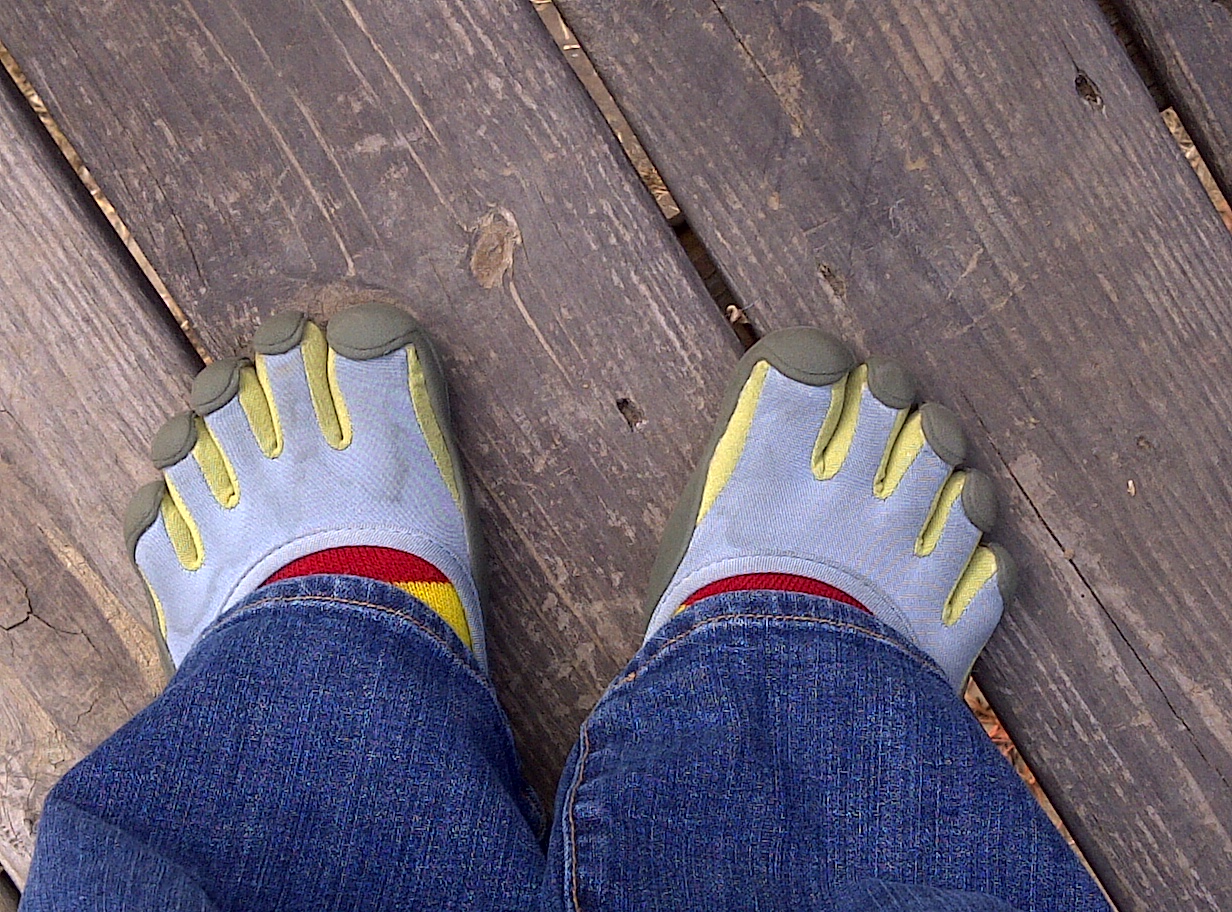
Several months ago, I purchased a pair of Vibram Five Fingers shoes.  In case you haven’t seen them, they are pictured here (made even more obnoxious by the addition of striped socks – I am on a mission to find more toed socks today as all the toed socks I own are some variation of stripes or hearts).  I personally find these shoes to be the most comfortable pair I own; it feels like walking around in your socks all day.  I’ve had a really bad case of plantar fasciitis among all of the other issues my feet have had from birth, and, rather counterintuitively, walking and running in these shoes or barefoot is helping tremendously.  However, I do not recommend these shoes to anyone without a healthy sense of humor and at least a small dose of confidence, for you will be mocked.

My Five Fingers have been conversation starters as well as the butt of many jokes around the office (I now wave goodbye to my office roommate with my toes whenever I’m wearing them) and various checkout lines.  I have adopted a new motto regarding my footwear, though: Blessed are you who are mocked for your choice in shoes, for your feet shall not ache nor blister.  Perhaps slightly sacrilegious, but true in my case.  I tend to forget what they look like, so I forget that other people might be surprised by my footwear.

So, last weekend while I was waiting for a pickup order at a steakhouse restaurant, I was not surprised to see someone glaring with disapproval and horror at the outline of my toes.  What made this situation downright hilarious was the disgusted woman’s attire: plaid pajama pants, hooded sweatshirt, and FUZZY PINK FLIP FLOP SLIPPERS!  I barely avoided snorting with laughter when I caught her looking at my shoes because I thought, “At least I have on real pants,”  and then, “Pot, meet kettle.”

That moment has made me laugh all week, but it also made me think about how many times we do that on a daily basis.  How often do I disdain someone in spite of all of my foibles and imperfections?  I honestly try not to criticize someone else without considering my faults first.  I suppose I have this cartoon-like image of myself with a plank in my eye holding tweezers to someone else’s eye.  I don’t always succeed at thinking before critiquing, and I know I fail most often with my husband and my family.  But the look on that woman’s face coupled with her similarly ridiculous choice in footwear demonstrated the absurdity of passing judgment on others.  It appears that we’re all just a bunch of pots calling kettles black.

Friendship

This is from an Oswald Chambers lesson in My Utmost for His Highest: “Friendship is rare on earth. It means identity in thought and heart and spirit.  The whole discipline of life is to enable us to enter into this closest relationship with Jesus Christ.  We receive His blessings and know His Word, but do we know Him?”

When I first read those sentences, I was immediately struck by their beauty and simplicity – so much that I read them several times. On first glance, I was considering that true friendship as described by Chambers is extremely rare, and I am blessed to experience its touches every day in a lot of often unexpected places.  I certainly have a few “go-to” friends with whom I share “identity in thought and heart and spirit”; they are my earthly anchors, and they are truly golden.  The silver bits come from the unexpected touches of shared identity: a word or a hug from a new friend; a message from someone you haven’t seen in years; a shared experience you wouldn’t have been able to imagine.  Essentially, these are the times that we stop everything else and take the time to actually communicate on the heart and soul level – the moments that seem to hang crystalized in our memories because of the insight we gained or the glimpse of depth we each contain but rarely share.

On the repeated readings of that quotation, I began to consider the last few sentences.  Chambers said the whole aim of our lives is to know Christ in this intimate manner.  “We receive His blessings and know His Word, but do we know Him?”  It isn’t enough for me to just read the Bible on a regular basis or pray on a regular basis if I am not taking time to search out the person of Christ through those disciplines.  Do I know him, or do I just know about him?  I can tell you my husband’s personal history, recite stories from his childhood, quote the details of his work truck specifications, and give you his clothing sizes.  But that is meaningless without the intimate knowledge that comes from almost a decade of marriage: I can read the micro expressions on his face and tell you what kind of mood he’s in; I know his likes and dislikes (although he still manges to pull off a lot of surprises on me there); I can anticipate his reactions to situations at work (and to my insane moments).  Those details are unknowable if you stop at the surface or spend little time with someone.

My husband and I will have been married ten years in May; I have been a professing Christian nearly three times longer.  I’m not sure that I could honestly tell you more intimate details about Christ than I can about my husband.  I can tell you innumerable details gleaned from a lifetime of church and Bible study, but intimate details are a horse of a different color.  In some respects, that is because it is easier to obtain intimate knowledge of a physical being you share a home with.  But mostly, it tells me I need to spend more time with Christ.  This does not mean I should cloister myself for hours or days, although I do find that a daily time for study and meditation and prayer keep me more focused on finding Christ in the intimate details of my life.  As Oswald Chambers said, “the whole discipline of life” should serve to draw us closer to Jesus.  I don’t know what your life holds, but my current discipline of life involves being a wife, keeping house, working, and writing, just to name a few.  I should have intimate knowledge of God through each and every pursuit; if not, I need to either find Christ in that pursuit or abandon it altogether.

I think some people struggle with Christianity over the rules and regulations.  We humans impose a lot of rules and laws on each other in an attempt to sanctify humanity by preventing some infraction of morality.  While morality as the result of a pure and honest heart is admirable, morality for the sake of morality quickly becomes self-righteousness and dictatorial.  It turns Christianity into a tool for condemnation and horrible acts of cruelty, like the Westboro Baptist Church folks who protest military funerals.  That is not the love of Christ; it is not love at all except possibly the love of self.  While I may not feel completely confident in my intimacy with Christ, I do know that the more we know him intimately – when we do justly, love mercy, and walk humbly with God (Micah 6:8) – then the more details and disciplines fall into place.

I think I need to add to my resolution list to search for a deeper intimacy with Christ than I have with anyone else.  How amazing would it be to be able to tell someone about God’s micro expressions?  Moses could have; the disciples could have.  I want to translate all of the knowledge I have acquired about God into close friendship and intimacy.  I can imagine nothing greater than to know God as he knows us.  While the full realization of that knowledge isn’t possible this side of heaven, we can begin here on earth.